RAS Water Quality Parameters Explained: A Reference Guide
Ammonia, nitrite, and dissolved oxygen tend to dominate discussions of RAS water quality, and for good reason — they are the parameters most likely to cause acute mortality events. But a stable RAS depends on a wider set of interacting parameters, several of which don't threaten fish directly but determine how the 'headline' parameters behave.
pH: The Parameter That Changes Everything Else
pH governs the chemical equilibrium behind several other parameters, most importantly ammonia toxicity — the proportion of total ammonia present as the highly toxic unionized form (NH₃) rises sharply as pH increases (University of Florida IFAS Extension, FA031: Ammonia in Aquatic Systems). University extension guidance frames pH as a 'master variable' precisely because of this cascading effect on other chemistry (eXtension Foundation, "Water Quality in Aquaculture"). Nitrification itself is also pH-sensitive: the bacteria performing ammonia and nitrite oxidation have documented pH optima (ScienceDirect, "Nitrification kinetics of biofilm as affected by water quality factors").
Alkalinity: The Buffer That Prevents pH Crashes
Alkalinity measures water's capacity to resist pH change, and nitrification actively consumes alkalinity as a byproduct — meaning a RAS biofilter is constantly working against its own chemical buffer. University extension guidance highlights alkalinity monitoring specifically because a system can appear stable on ammonia and pH readings alone while alkalinity quietly depletes (New Mexico State University, CR680: Important Water Quality Parameters in Aquaponics Systems).
Salinity and Temperature: Species-Defined, Not Universal
Unlike pH or dissolved oxygen, salinity and temperature targets are entirely species-dependent. Extension guidance emphasizes that these two parameters function as the 'operating envelope' the rest of the system is designed around (Ohio State University South Centers, "A Fish Farmer's Guide to Understanding Water Quality").
Why These Parameters Must Be Read Together
Reference material from the University of Florida's shellfish aquaculture program presents water quality parameters explicitly as an interacting system, where a change in one predictably shifts others (University of Florida IFAS, Basic Water Quality Parameters for Aquaculture).
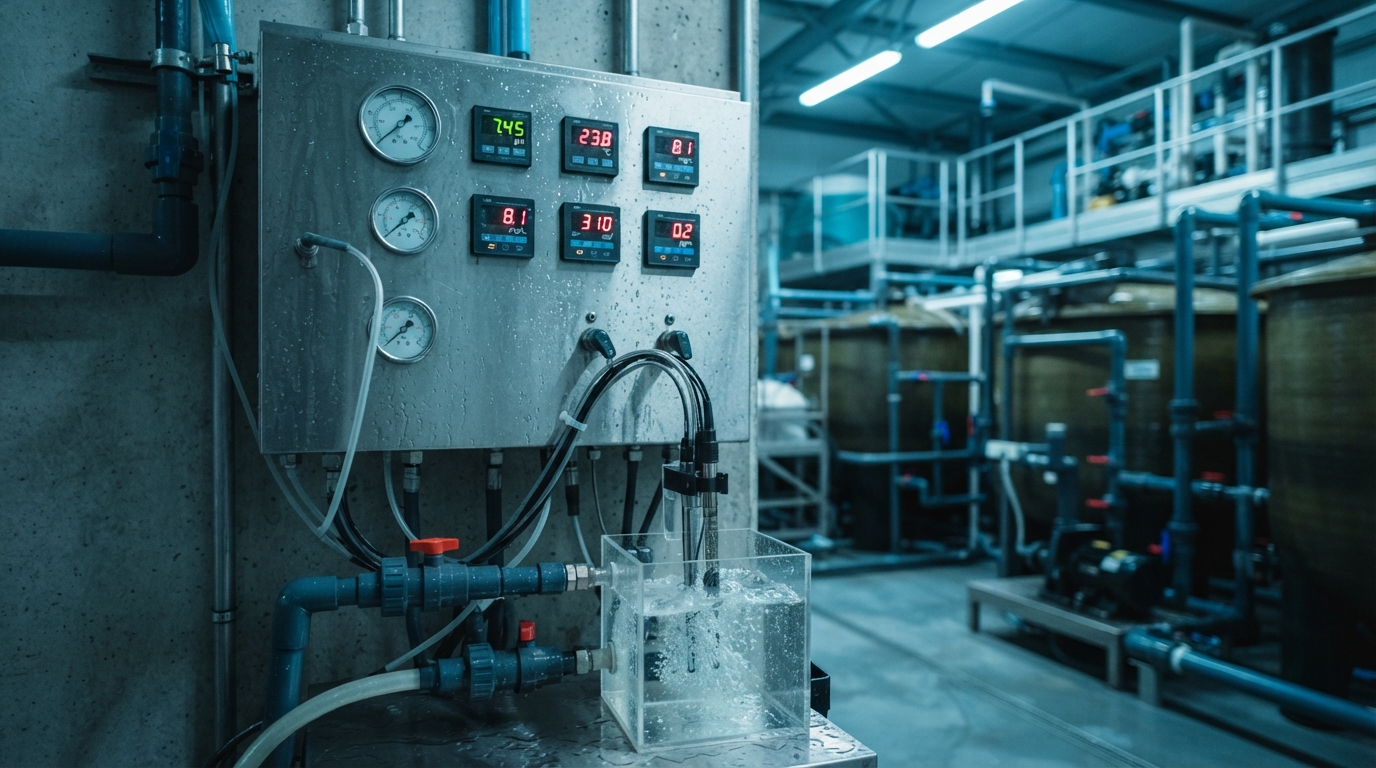
ADEC's RAS monitoring and control systems track every interacting water quality parameter, not just the headline few. See our RAS technology →
Learn moreWhich water quality parameter should be checked most frequently?+
Dissolved oxygen changes fastest and needs the most frequent monitoring, while alkalinity and salinity typically drift more slowly.
Can good water quality readings still coexist with fish stress?+
Yes. Chemical water quality parameters can be within target range while behavioral or physiological stress indicators suggest a problem.
Why does alkalinity need to be actively managed in RAS but not always in ponds?+
Because nitrification — concentrated and continuous in a RAS biofilter — consumes alkalinity faster than it typically depletes in a larger, more chemically buffered pond.
- University of Florida IFAS Extension. FA031: Ammonia in Aquatic Systems.
- eXtension Foundation. Water Quality in Aquaculture. Freshwater Aquaculture.
- Nitrification kinetics of biofilm as affected by water quality factors. ScienceDirect.
- New Mexico State University. CR680: Important Water Quality Parameters in Aquaponics Systems.
- Ohio State University South Centers. A Fish Farmer's Guide to Understanding Water Quality.
- University of Florida IFAS. Basic Water Quality Parameters for Aquaculture.
Written and reviewed by ADEC's in-house aquarium life support and recirculating aquaculture engineers. ADEC designs, builds and operates turnkey aquarium and RAS facilities across the GCC, and is a member of the European Union of Aquarium Curators (EUAC), EUOTA and the European Aquaculture Society (AquaEAS), with CE-certified OCEANTECH™ equipment.
Get new articles in your inbox
Occasional, science-based insights on aquarium LSS and RAS aquaculture. No spam.