Dissolved Oxygen and Aeration Strategy in High-Density RAS
Of every water quality parameter tracked in a recirculating aquaculture system, dissolved oxygen (DO) changes the fastest and forgives the least. Fish can tolerate a slow drift in pH or a gradual nitrate increase for hours or days; a serious DO crash can cause mortality in minutes. Understanding what actually consumes oxygen in a RAS — and how different aeration technologies replace it — is fundamental to operating any high-density system safely.
What Consumes Oxygen in a RAS
Two distinct biological processes compete for dissolved oxygen in every RAS: fish respiration and bacterial respiration inside the biofilter. A foundational reference from the University of Florida IFAS Extension notes that oxygen consumption rises directly with fish biomass, feeding rate, and water temperature — meaning the exact conditions that maximize production are the same conditions that push oxygen demand to its highest point (University of Florida IFAS Extension, FA002: Dissolved Oxygen for Fish Production). Academic course materials on RAS fish metabolism describe this relationship quantitatively: oxygen consumption per unit of fish biomass increases with both body temperature and metabolic activity (University of Tennessee, "Recirculation Aquaculture: Fish Metabolism").
Aeration Versus Oxygenation
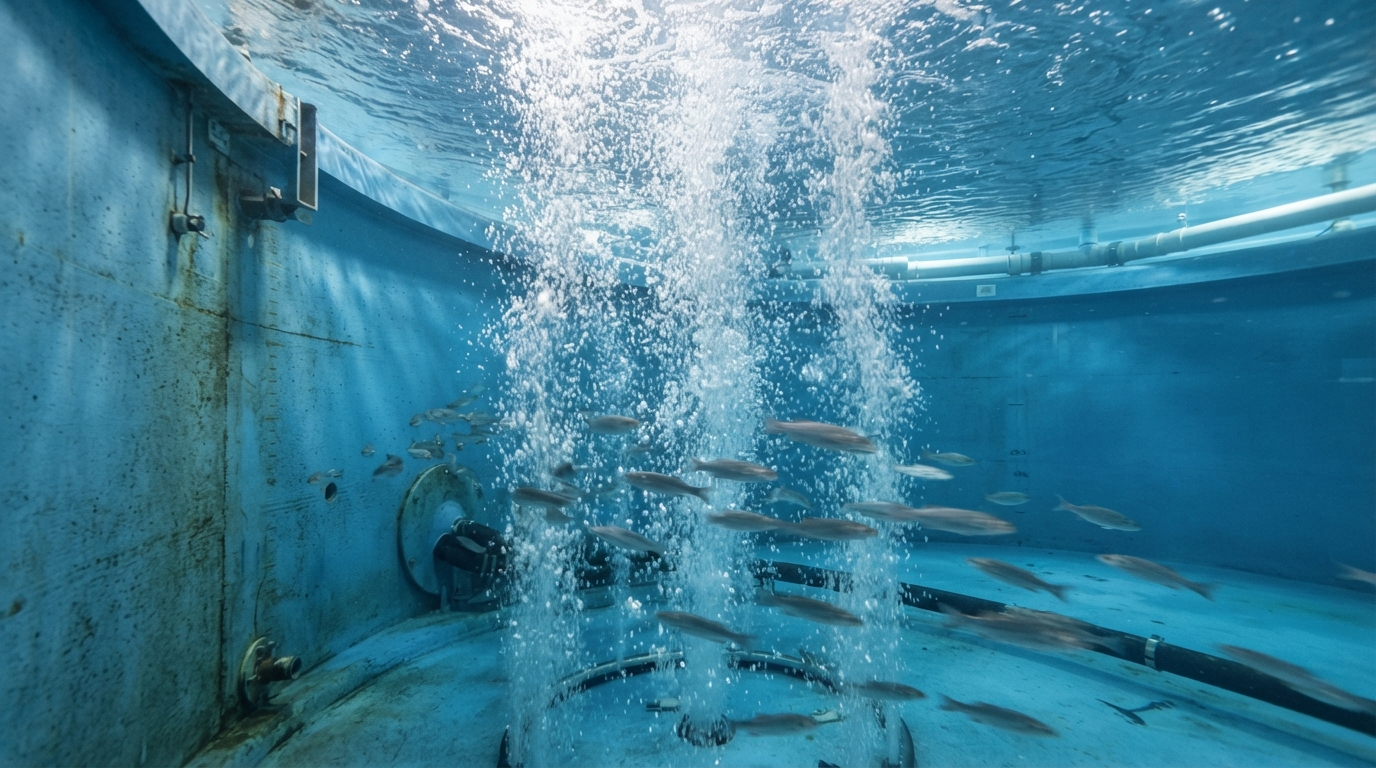
Standard air-based aeration is limited by the fact that atmospheric air is only about 21% oxygen, capping how much DO can realistically be dissolved. High-density RAS facilities frequently move to pure oxygen injection — via low-head oxygenators, oxygen cones, or diffusers — specifically because it allows water to be supersaturated with oxygen relative to what air alone can achieve (Texas A&M AgriLife Extension, "Fish Farming in Recirculating Aquaculture Systems (RAS)"). Recent modeling research treats DO as a control-systems problem, developing predictive models and controllers to manage dissolved oxygen dynamically, reflecting how oxygen demand fluctuates through the day in step with feeding activity, sometimes following a measurable circadian pattern (ScienceDirect, "Modeling and control of dissolved oxygen in recirculating aquaculture systems").
Flow Rate and Distribution Matter as Much as Total Oxygen
Research examining the effect of flow rate and dissolved oxygen distribution in recirculating aquaculture tanks found that DO stratification can occur even when total system oxygen input appears adequate, driven by tank hydraulics and flow pattern rather than oxygenation equipment alone (ScienceDirect, "Effect of flow rate and dissolved oxygen distribution on aeration of the recirculating aquaculture tank").
Why DO Failure Escalates Faster Than Other Parameters
Unlike ammonia or nitrite, which accumulate over hours, dissolved oxygen can be depleted within minutes if aeration or oxygen supply is interrupted. This is the underlying reason commercial RAS facilities typically build redundancy directly into oxygenation systems rather than treating it as an optional safeguard.
ADEC designs RAS oxygenation and aeration systems with built-in redundancy for high-density production. Explore our RAS technology →
Learn moreWhat dissolved oxygen level is considered safe for most farmed fish?+
Safe ranges vary by species and life stage — cold-water species generally need higher DO saturation than warm-water species, and juvenile stages are typically more sensitive than adults.
Why does a RAS need more oxygenation capacity than the fish alone would suggest?+
Because the biofilter's nitrifying bacteria also consume dissolved oxygen continuously, meaning total system oxygen demand is fish respiration plus biofilter respiration.
Can a RAS have 'too much' dissolved oxygen?+
Supersaturation beyond safe limits can cause gas bubble disease in fish, which is why oxygen injection systems are engineered and monitored to a target range.
- University of Florida IFAS Extension. FA002: Dissolved Oxygen for Fish Production.
- University of Tennessee. Recirculation Aquaculture: Fish Metabolism.
- Texas A&M AgriLife Extension. Fish Farming in Recirculating Aquaculture Systems (RAS).
- Modeling and control of dissolved oxygen in recirculating aquaculture systems: A circadian rhythm analysis approach and GSMPC controller. ScienceDirect.
- Effect of flow rate and dissolved oxygen distribution on aeration of the recirculating aquaculture tank. ScienceDirect.
Written and reviewed by ADEC's in-house aquarium life support and recirculating aquaculture engineers. ADEC designs, builds and operates turnkey aquarium and RAS facilities across the GCC, and is a member of the European Union of Aquarium Curators (EUAC), EUOTA and the European Aquaculture Society (AquaEAS), with CE-certified OCEANTECH™ equipment.
Get new articles in your inbox
Occasional, science-based insights on aquarium LSS and RAS aquaculture. No spam.