Protein Skimming Explained: The Chemistry Behind It
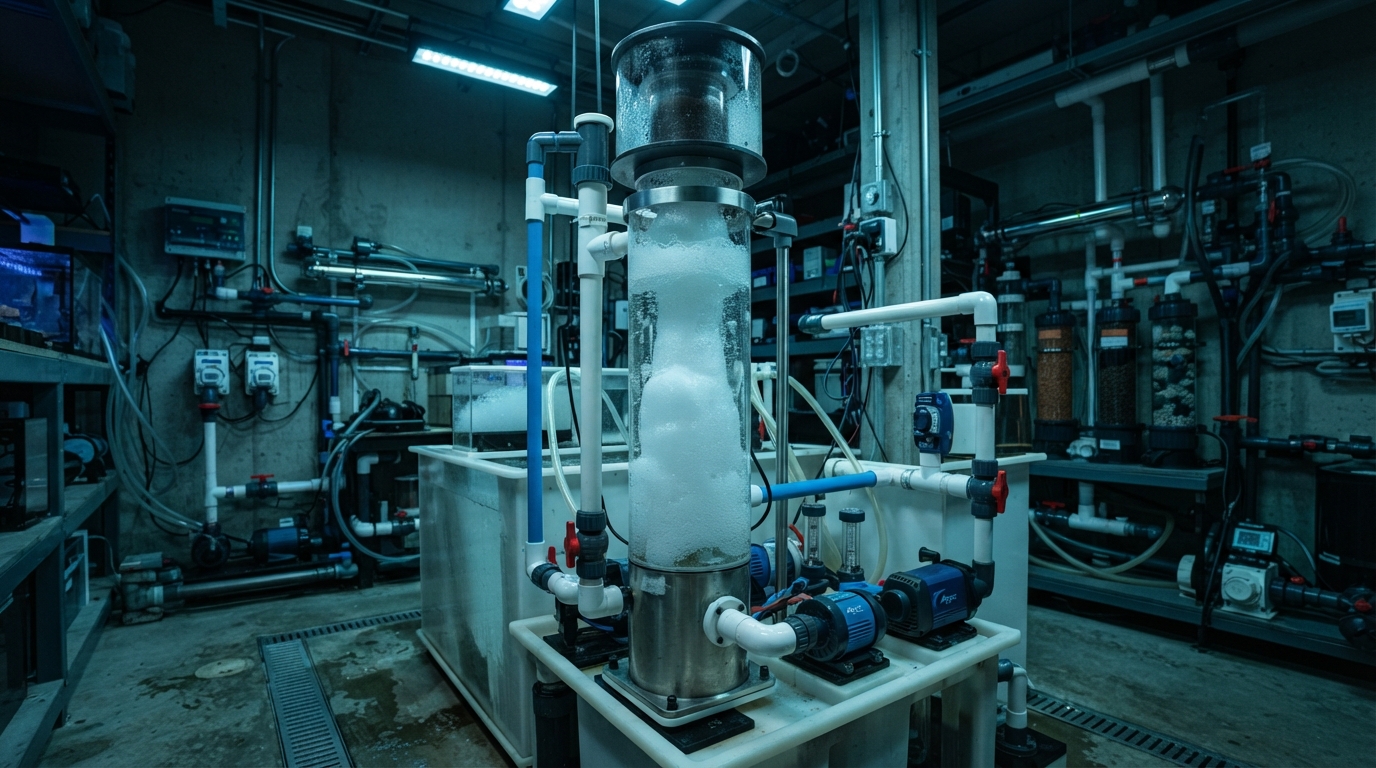
Protein skimming is one of the most distinctive technologies in marine life support systems, and one of the least intuitive to explain from first principles. Unlike mechanical or biological filtration, which remove particles or convert dissolved compounds chemically, a protein skimmer removes dissolved organic material using nothing but air bubbles and the physical chemistry of seawater itself.
The Underlying Mechanism: Foam Fractionation
Protein skimming is a specific application of a broader separation process called foam fractionation, covered as its own chapter in Wiley's academic reference text on aquaculture engineering: fine air bubbles are introduced into a column of water, and dissolved organic compounds — many of which are surface-active, meaning they preferentially collect at the air-water interface — attach to the bubble surfaces as they rise, forming a stable foam that concentrates those compounds until it overflows into a collection cup and is physically removed from the system (Wiley, Aquaculture Engineering, "Protein Skimming, Flotation, Coagulation and Flocculation"). This is fundamentally a physical separation process, not a biological or chemical reaction — it works because of surface tension and molecular behavior at the bubble interface.
Why This Matters Before Biological Filtration
The strategic value of protein skimming lies in where it sits in the treatment sequence: by removing dissolved organic compounds before they break down, a skimmer reduces the load that would otherwise reach the biofilter as ammonia after bacterial decomposition. Foundational research applying foam fractionation to aquacultural systems established this principle directly, demonstrating that removing organics before mineralization measurably reduces the downstream biological treatment burden. Later research quantifying foam fractionation efficiency in a recirculating seabass system confirmed measurable removal of both particulate matter and heterotrophic bacteria — showing that skimming's benefits extend beyond dissolved organics into water clarity and microbial load reduction (ScienceDirect, "Foam fractionation efficiency in particulate matter and heterotrophic bacteria removal from a recirculating seabass system").
Why Skimming Works in Saltwater but Not Freshwater
Foam stability is the key variable that explains why protein skimming is standard in marine systems but rarely used in freshwater ones: seawater's higher ionic strength and dissolved salt content stabilize the bubble-foam interface enough for a persistent, collectible foam to form, while freshwater generally lacks the surface chemistry needed to sustain stable foam under the same conditions. This is a direct physical chemistry difference, not simply a difference in equipment design, and it is a foundational reason freshwater LSS designs rely more heavily on mechanical and biological filtration to carry the equivalent treatment load.
Measuring Skimmer Performance
Because skimming performance depends on bubble size, contact time, and water chemistry, it can vary significantly between installations even with similar equipment. Research on foam fractionation efficiency using a vacuum airlift configuration specifically studied particulate matter removal performance under controlled conditions, contributing to a broader body of engineering literature aimed at making skimmer performance more predictable and comparable across designs (ScienceDirect, "Foam fractionation efficiency of a vacuum airlift"). Earlier feasibility research on foam fractionation for removing dissolved and suspended solids from fish culture water helped establish some of the earliest quantitative benchmarks for this technology in aquatic systems.
ADEC specifies and integrates protein skimming sized to your exhibit's actual bioload. Explore our LSS engineering approach →
Learn moreDoes protein skimming replace biological filtration?+
No. Skimming reduces the organic load reaching the biofilter, but it does not remove ammonia, nitrite, or nitrate directly — biological filtration remains necessary to manage those compounds.
Why do some marine exhibits skim more aggressively than others?+
Skimming intensity is typically matched to bioload (the amount of waste-producing life in the system) and to the specific water clarity and nutrient targets for that exhibit — heavily stocked systems generally benefit from more aggressive skimming.
Can a protein skimmer remove too much from the water?+
Yes, in principle — aggressive skimming can strip beneficial trace organics and dissolved nutrients along with waste compounds, which is why skimmer intensity is a tuned operational parameter rather than a simple 'more is better' setting.
- Protein Skimming, Flotation, Coagulation and Flocculation. Aquaculture Engineering, Wiley Online Library.
- Foam fractionation applied to aquacultural systems. ResearchGate.
- Foam fractionation efficiency in particulate matter and heterotrophic bacteria removal from a recirculating seabass (Dicentrarchus labrax) system. ScienceDirect.
- Foam fractionation efficiency of a vacuum airlift—Application to particulate matter removal in recirculating systems. ScienceDirect.
- Feasibility of using foam fractionation for the removal of dissolved and suspended solids from fish culture water. ScienceDirect.
Written and reviewed by ADEC's in-house aquarium life support and recirculating aquaculture engineers. ADEC designs, builds and operates turnkey aquarium and RAS facilities across the GCC, and is a member of the European Union of Aquarium Curators (EUAC), EUOTA and the European Aquaculture Society (AquaEAS), with CE-certified OCEANTECH™ equipment.
Get new articles in your inbox
Occasional, science-based insights on aquarium LSS and RAS aquaculture. No spam.