UV vs. Ozone Disinfection in Aquarium LSS: A Comparison
Mechanical and biological filtration remove solids and manage dissolved waste, but neither directly controls free-floating pathogens, parasites, or bacteria circulating through the water column. That is the specific job of disinfection — and in aquarium LSS design, the two dominant technologies, ultraviolet (UV) irradiation and ozone, work through entirely different mechanisms with different trade-offs.
How Each Technology Actually Works
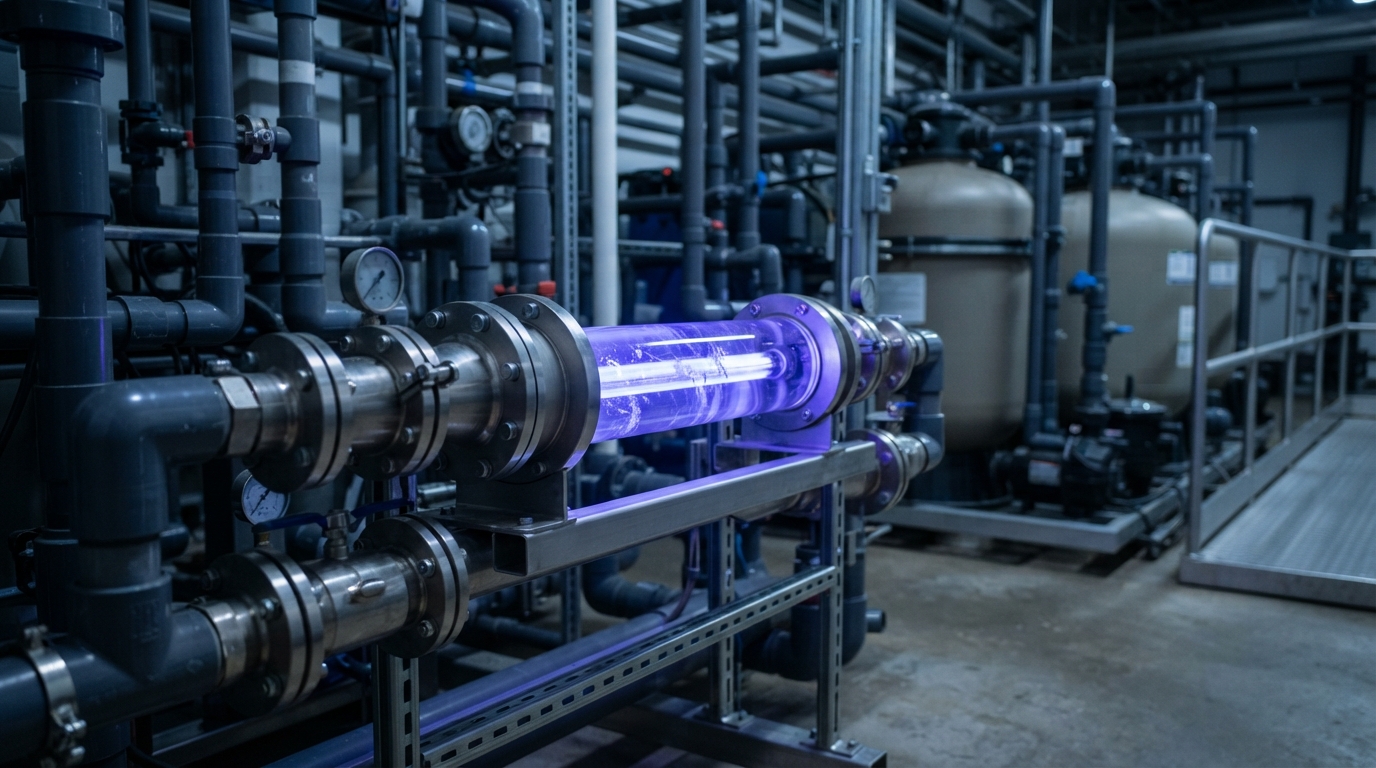
UV disinfection exposes water to ultraviolet light at a specific wavelength that damages the DNA of microorganisms passing through the treatment chamber, preventing them from reproducing without adding any chemical to the water. Ozone (O₃) is a powerful oxidizing gas, typically generated on-site and injected into the water, that disinfects by directly oxidizing cell walls and organic matter — a chemically active process rather than a purely physical one. Research directly comparing water disinfection by ozonation versus UV irradiation in a brackish water RAS raising Pacific white shrimp found that ozonation outperformed UV on nitrite/nitrate control, microbial community stability, and reduction of the pathogen Vibrio alginolyticus — though the study tested UV only at its manufacturer-recommended power setting and found ozone's anti-Vibrio effect to be pH-dependent, so the result should be read as evidence for that specific system configuration rather than a fixed universal ranking of the two technologies (Wiley/PubMed, Journal of Fish Diseases, "Water disinfection by ozonation has advantages over UV irradiation in a brackish water recirculation aquaculture system for Pacific white shrimp").
Combining Both Technologies
Because UV and ozone act through different mechanisms, research has explored using them together rather than as either/or alternatives. A study on ozonation followed by UV irradiation in a freshwater recirculating system found that the sequential combination provided effective bacterial inactivation, suggesting the two technologies can be complementary rather than purely competing choices in LSS design (ScienceDirect, "Ozonation followed by ultraviolet irradiation provides effective bacteria inactivation in a freshwater recirculating system"). Engineering research on the process requirements for achieving full-flow disinfection using both ozonation and UV irradiation similarly treated the two as parts of an integrated disinfection train rather than isolated technology choices, with specific process parameters required for each to perform reliably at commercial flow rates.
The Trade-Off Ozone Research Has Uncovered
Ozone's oxidizing power is also the source of its main documented drawback: because it is chemically reactive, it must be carefully dosed and off-gassed to avoid residual ozone or its reaction byproducts harming livestock. Research examining both positive and negative effects of advanced oxidation (ozone and combined ozone/UV treatment) in recirculating aquaculture water found that while these treatments improved measured water quality, they were also associated with an increase in antibiotic resistance genes detected in the system's microbial community — a finding that adds real nuance to any simple 'ozone is more effective' conclusion and underscores that disinfection technology choice carries second-order biological consequences worth monitoring (ScienceDirect, "Positive and negative effects of recirculating aquaculture water advanced oxidation").
UV Performance Is Also Condition-Dependent
UV disinfection is not immune to its own performance variables. University research evaluating UV disinfection performance in recirculating systems found that dose delivery is affected by water clarity, flow rate, and lamp condition, meaning UV systems require monitoring and maintenance (lamp replacement, sleeve cleaning) to sustain rated performance rather than being an 'install and forget' technology (Virginia Tech, "Evaluation of UV Disinfection Performance in Recirculating Systems").
ADEC specifies UV, ozone, or combined disinfection trains based on your exhibit's specific biosecurity needs. Explore our LSS engineering →
Learn moreIs ozone always more effective than UV?+
Not universally — the comparative research shows ozone offering advantages in specific applications and water types, but the correct choice depends on target organisms, water chemistry, and system design rather than one technology being categorically superior.
Does UV leave any chemical residue in the water?+
No — UV disinfection is a purely physical process (light exposure) and does not add or leave behind any chemical residue, which is one reason it is often chosen where residual chemical exposure is a specific concern.
Why does ozone need to be carefully monitored after dosing?+
Because ozone is a reactive oxidizing gas, any residual ozone reaching the culture tank can harm livestock, so ozone systems require reaction/contact time and off-gassing or residual monitoring before treated water reaches exhibit animals.
- Water disinfection by ozonation has advantages over UV irradiation in a brackish water recirculation aquaculture system for Pacific white shrimp (Litopenaeus vannamei). Journal of Fish Diseases, PubMed.
- Ozonation followed by ultraviolet irradiation provides effective bacteria inactivation in a freshwater recirculating system. ScienceDirect.
- Process requirements for achieving full-flow disinfection of recirculating water using ozonation and UV irradiation. ScienceDirect.
- Positive and negative effects of recirculating aquaculture water advanced oxidation: O3 and O3/UV treatments improved water quality but increased antibiotic resistance genes. ScienceDirect.
- Evaluation of UV Disinfection Performance in Recirculating Systems. Virginia Tech.
Written and reviewed by ADEC's in-house aquarium life support and recirculating aquaculture engineers. ADEC designs, builds and operates turnkey aquarium and RAS facilities across the GCC, and is a member of the European Union of Aquarium Curators (EUAC), EUOTA and the European Aquaculture Society (AquaEAS), with CE-certified OCEANTECH™ equipment.
Get new articles in your inbox
Occasional, science-based insights on aquarium LSS and RAS aquaculture. No spam.