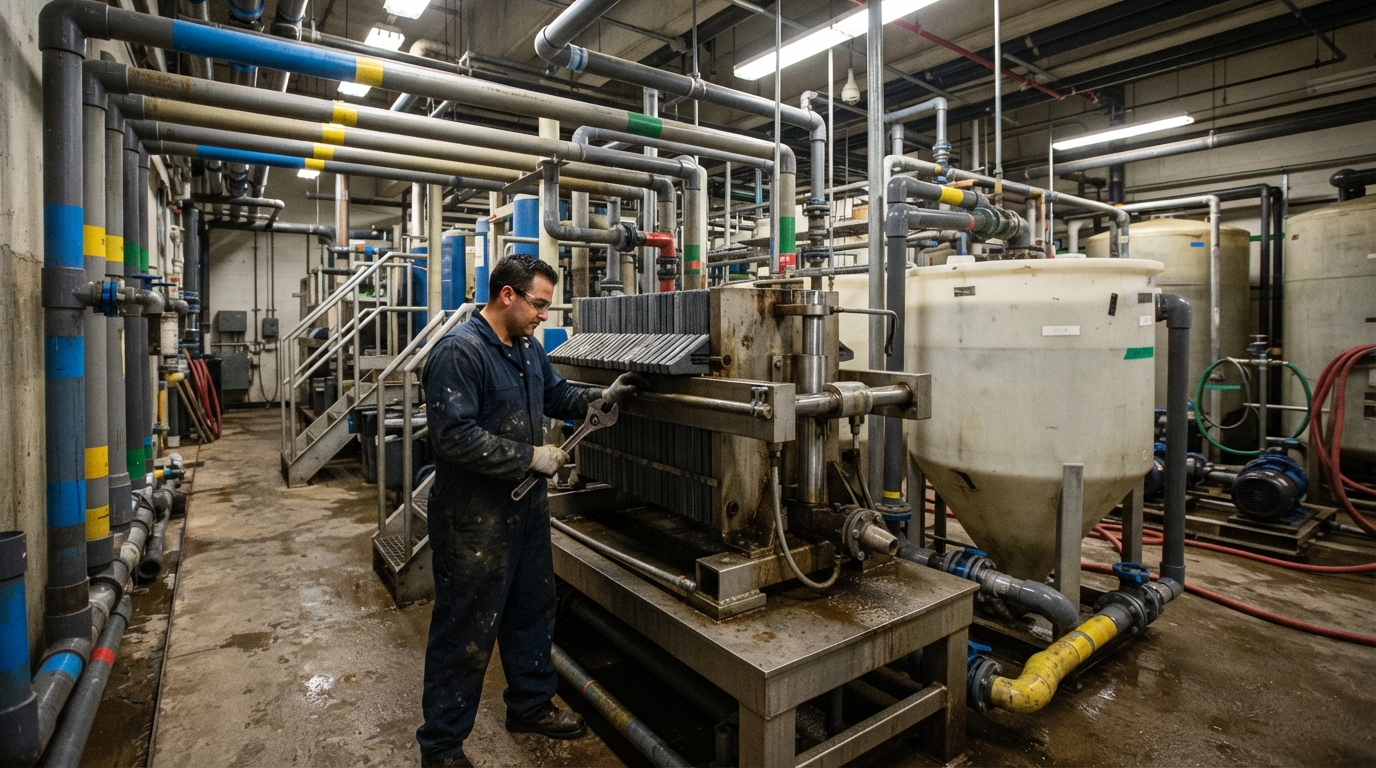
Waste and Sludge Management in Aquarium Life Support Systems
Drum filters and screens do the work of pulling solids out of exhibit water, but that capture is only half the waste stream's journey. What a facility does with the resulting sludge — how it is thickened, dewatered, stabilized, and ultimately disposed of or beneficially reused — carries its own technical and regulatory weight, and it is frequently under-engineered relative to the capture side of the system.
What Aquarium Sludge Actually Contains
Captured solids from fish culture and exhibit systems are not inert grit; they are organically rich, nutrient-dense material. Reviews of aquaculture solids report that the solid fraction can carry roughly 7–32% of total nitrogen and 30–84% of total phosphorus present in the system's waste stream, with the remainder dissolved in the water column (Turcios & Papenbrock, 2014). Fresh aquaculture sludge is frequently described as a good "slow-release" organic fertilizer candidate because of its organic matter, nitrogen, and phosphorus content, though it is comparatively low in potassium (Turcios & Papenbrock, 2014). That nutrient density is precisely why unmanaged sludge is also an environmental liability if it is not handled deliberately — the same nitrogen and phosphorus that make it a fertilizer candidate make it a eutrophication risk if discharged untreated.
Thickening and Dewatering
Solids leaving a drum filter or settling basin typically arrive as a dilute slurry, often in the range of roughly 1–10% solids concentration, which is too wet for economical handling or transport (FAO, Wastewater treatment in the fishery industry). The standard next step in recirculating systems is gravity thickening in settling basins, tube or plate settlers, or swirl separators, followed by a dewatering stage (Ebeling & Timmons, in Tidwell, 2012). Geotextile bags — porous fabric containers that receive the slurry, retain solids, and allow water to drain back to the system or to treatment — are a widely documented dewatering method in aquaculture settings, and their performance can be substantially improved with coagulant or flocculant pretreatment that also strips out dissolved phosphorus before it leaves the bag's filtrate (Ebeling & Timmons, in Tidwell, 2012). Mechanical belt or screw presses achieve similar concentration but require more capital and maintenance than gravity-fed bag systems, which is one reason the latter remain common at mid-sized facilities.
Disposal and Beneficial Reuse Pathways
Once dewatered, aquaculture sludge has several documented end-use routes: agricultural land application, composting, vermiculture (worm-based processing), and reed or drying-bed systems (Turcios & Papenbrock, 2014). Land application is generally the lowest-cost option where it is permitted and agronomically appropriate (Ebeling & Timmons, in Tidwell, 2012). A newer and increasingly studied pathway is anaerobic digestion for biogas recovery: a 2023 study digesting Atlantic salmon and rainbow trout RAS sludge found methane yield increased with feedstock solids concentration — a 3.5% total-solids feed produced roughly 23% more methane per gram of volatile solids than a 1.5% feed (519 vs. 422 mL CH₄/g VS) — without destabilizing the digestion process, though hydrogen sulfide co-production (1,800–2,100 ppm) means the biogas needs scrubbing before energy use (Choudhury et al., 2023).
The Marine Salinity Complication
Public aquarium LSS teams running marine or brackish exhibits face a constraint that freshwater aquaculture operations do not: salt. A 2022 study applying mariculture sludge to paddy soil found that soil pH and salinity were the dominant limiting factors on crop performance, acting indirectly by suppressing bacterial diversity, nitrification- and denitrification-gene abundance, and soil enzyme activity as sludge dosage increased (Li et al., 2022). In practice, this means marine exhibit sludge cannot simply be routed to the same land-application or composting pathway as freshwater aquaculture solids without salinity screening, dilution, or an alternative disposal route — a consideration facility engineers should flag early when designing a disposal plan rather than discovering it after a hauling contract is signed.
Regulatory Considerations
Federal effluent limitation guidelines for aquatic animal production (40 CFR Part 451) apply to "concentrated aquatic animal production facilities" that discharge directly to U.S. waters and meet minimum production thresholds — generally 9,090 kg (20,000 lb)/year for cold-water flow-through facilities or 45,454 kg (100,000 lb)/year for warm-water or recirculating facilities (U.S. EPA, NPDES Aquaculture Permitting). Most public display and exhibit aquariums fall outside this production-based definition and, where they discharge to a municipal system rather than directly to surface water, are instead governed by local sewer-use ordinances and industrial pretreatment requirements rather than the CAAP effluent guidelines — a distinction worth confirming with the receiving utility rather than assuming either way. If sludge solids are ever land-applied or transferred to a municipal biosolids program, the general sewage sludge standards at 40 CFR Part 503 — covering pollutant ceiling concentrations, pathogen reduction classes, and agronomic application rates — set the baseline a receiving facility will expect the material to meet (40 CFR Part 503).
Planning sludge handling and disposal into your next exhibit build saves costly retrofits later — see how ADEC Dubai designs waste trains into complete aquarium facilities.
Learn moreCan exhibit aquarium sludge be composted like agricultural fish-farm sludge?+
Technically yes for freshwater systems, following the same composting and land-application pathways documented for aquaculture solids generally (Turcios & Papenbrock, 2014), but marine exhibit sludge needs salinity screening first, since high salt content is a documented limiting factor for soil and crop health (Li et al., 2022).
Does a public aquarium need an NPDES permit for its sludge or effluent?+
Only if it discharges directly to U.S. waters and meets the federal production thresholds for concentrated aquatic animal production facilities; most exhibit-only aquariums fall below those thresholds or discharge to a municipal sewer under local pretreatment rules instead (U.S. EPA, NPDES Aquaculture Permitting).
Is anaerobic digestion of aquarium sludge practical at exhibit scale?+
It is proven at research and farm scale for RAS fish sludge, with higher-solids feedstock improving methane yield (Choudhury et al., 2023), but hydrogen sulfide in the biogas and the capital cost of a digester mean it is more often viable for larger or multi-facility operations than a single small exhibit system.
- Turcios, A.E. & Papenbrock, J. (2014). Sustainable Treatment of Aquaculture Effluents—What Can We Learn from the Past for the Future? Sustainability, 6(2), 836–856.
- Li, Y., Hu, Y., Yan, C., Xiong, J., & Qiu, Q. (2022). pH and salinity are the dominant limiting factors for the application of mariculture sludge to paddy soil. Applied Soil Ecology, 175, 104463.
- Choudhury, A., Lepine, C., & Good, C. (2023). Methane and Hydrogen Sulfide Production from the Anaerobic Digestion of Fish Sludge from Recirculating Aquaculture Systems. Fermentation, 9(2), 94.
- Ebeling, J.M. & Timmons, M.B. (2012). Recirculating Aquaculture Systems. In Tidwell, J.H. (Ed.), Aquaculture Production Systems. Wiley-Blackwell.
- Food and Agriculture Organization of the United Nations. Wastewater treatment in the fishery industry — 6. Sludge treatment and disposal. FAO Fisheries Technical Paper.
- U.S. Environmental Protection Agency. Aquaculture NPDES Permitting.
- U.S. Environmental Protection Agency. 40 CFR Part 503 — Standards for the Use or Disposal of Sewage Sludge.
Written and reviewed by ADEC's in-house aquarium life support and recirculating aquaculture engineers. ADEC designs, builds and operates turnkey aquarium and RAS facilities across the GCC, and is a member of the European Union of Aquarium Curators (EUAC), EUOTA and the European Aquaculture Society (AquaEAS), with CE-certified OCEANTECH™ equipment.
Get new articles in your inbox
Occasional, science-based insights on aquarium LSS and RAS aquaculture. No spam.