Monitoring, Alarms, and Automation in Aquarium Life Support
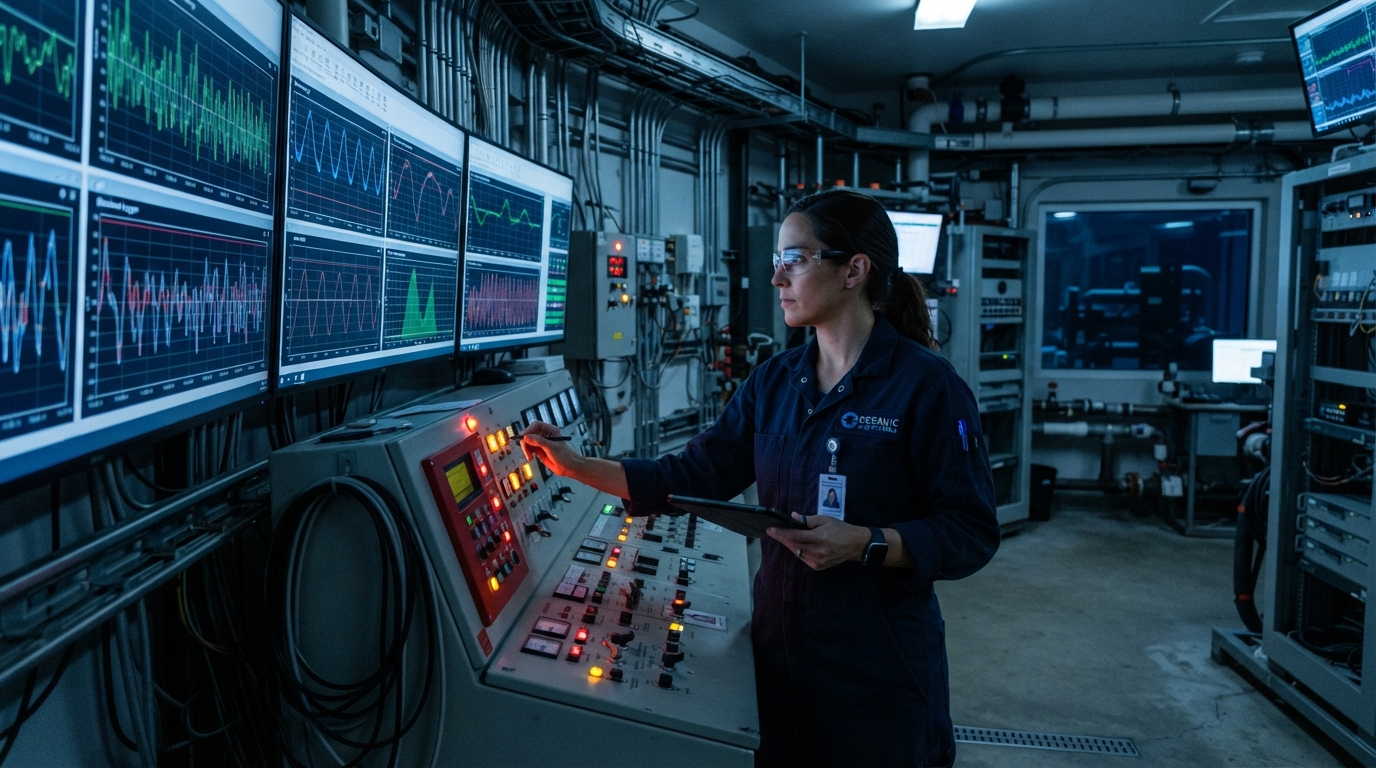
Duplicate pumps and backup generators only protect a system if someone finds out the primary equipment has failed. The layer that actually does that job — dissolved oxygen, pH, temperature, salinity, and ORP sensors feeding a SCADA or PLC-based control system that raises an alarm — is what turns a mechanical fault into a routine correction instead of a mortality event. This article looks at how that detection layer is built, where it fails, and what the research says about keeping it trustworthy.
Why Detection Speed Is the Real Variable
Water quality does not degrade on a convenient schedule. The U.S. Environmental Protection Agency's dissolved oxygen criteria document notes that oxygen concentrations below the level used in standard 24–96 hour mortality testing "can lead to mortality in minutes to a few hours" in acute low-DO events, and that some estuarine species died within minutes at concentrations near 0.25 mg/L (EPA, 2003). That gap between a slow laboratory LC50 curve and the real speed of a crash is exactly why continuous instrumentation — not a twice-daily manual check — is the baseline expectation for life support in systems holding valuable, sensitive collections. The Southern Regional Aquaculture Center's guidance on recirculating systems is blunt about the operational culture this requires: "Monitor water quality daily and maintain it within optimum ranges. STAY ALERT!" (Masser, Rakocy, and Losordo, 1999).
The Sensor Layer: What Each Probe Is Actually Watching
A typical LSS instrumentation set pairs dissolved oxygen and temperature probes with pH, salinity/conductivity, and sometimes ORP sensors, each reporting continuously to a logger or controller. A 2023 review of recirculating aquaculture system monitoring found that while real-time sensing is well established for basic parameters like DO, pH, and temperature, "real-time measurements of more advanced parameters still require further development," and cautioned that these systems "need competent users and require regular maintenance and calibration" to stay accurate (Lindholm-Lehto, 2023). The same review points to animal behavior — swimming activity, depth, and acceleration — as a secondary signal that can flag a water-quality problem before a chemical sensor does, which is a useful argument for pairing instrumentation with routine visual husbandry checks rather than treating sensors as a replacement for them.
Calibration, Drift, and Biofouling: Why Sensors Lie
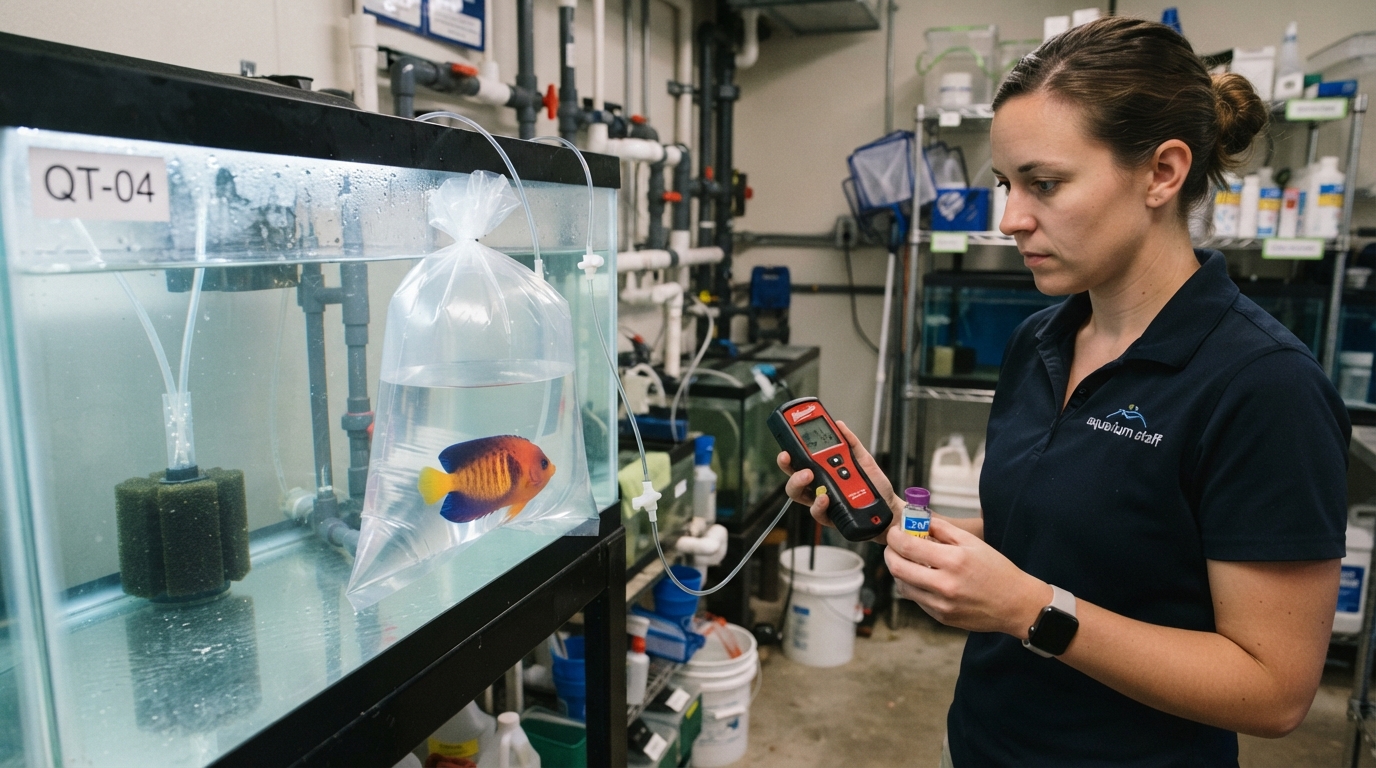
A sensor that is not reading correctly is often worse than no sensor at all, because staff trust a number that has quietly stopped being true. The U.S. Geological Survey's field manual for continuous water-quality monitors documents the mechanism directly for DO probes: "the Teflon membranes of DO sensors are susceptible to fouling; the membrane and retaining ring are susceptible to loss of elasticity; and the cathode-anode measuring electrodes are susceptible to chemical alteration" (Wagner et al., 2006). The same manual notes that in nutrient-enriched, warm water, "monitoring sites... may require maintenance as frequently as every third day," and it treats independent field checks — comparing the installed sensor against a separately calibrated handheld meter — as a required step before and after every service visit, not an optional audit.
Biofouling is not a slow nuisance; it is fast. A peer-reviewed study of marine environmental sensors found that fouling "can disrupt the quality of measurements, sometimes in less than a week," and that during productive (warm, nutrient-rich) periods it "can grow very rapidly and lead to poor data quality in less than two weeks," with even a thin biofilm on optical components enough to distort readings (Delauney, Compère, and Lehaitre, 2010). For pH specifically, NOAA's quality-control manual for continuous sensors warns that standard potentiometric probes drift enough that "in the absence of reference data points such as water samples collected nearby, drift often cannot be detected or corrected" — meaning a drifting pH sensor can report a false sense of stability for a long time before anyone notices (U.S. IOOS, 2019). The practical takeaway for an LSS program is the same across all three sources: calibration intervals should be set by local fouling rate and water chemistry, not by a generic manufacturer default, and every automated reading needs a periodic independent check against a reference measurement.
SCADA, Automation, and Getting the Alert to a Person
Sensing is only useful once it reaches a human who can act. Guidance for recirculating systems has long recommended that "automatic phone alarm systems are inexpensive and are essential in alerting key personnel to power failures or water level fluctuations," including dial-in systems that let a manager check status remotely, paired with an automatic transfer switch that starts backup power "in case personnel are not present" (Masser, Rakocy, and Losordo, 1999). Modern systems extend this with networked push notifications rather than phone trees. A 2025 peer-reviewed description of a low-cost IoT monitoring and alerting platform for recirculating systems reported that its pump-failure alarm, delivered as an immediate push notification when sensor readings crossed a predefined threshold, "was crucial in preventing mortalities among the fish during the experimental period" — a direct, documented link between alarm delivery speed and animal survival (Malandrakis, 2025). The same study used simple statistical filtering (discarding the highest and lowest readings from repeated samples before evaluating a threshold) to cut transient noise that would otherwise generate spurious alerts.
When Alarms Fail: Lessons From Outside Aquariums
The clearest documented failures of alarm systems come from industrial process safety investigations, and they are directly relevant to LSS design because the failure mode — an alarm that should have fired but didn't, or a display that didn't make the problem visible — is identical. The U.S. Chemical Safety and Hazard Investigation Board's investigation into the 2005 BP Texas City refinery explosion found that a redundant high-level alarm on the process vessel "did not activate" during the dangerous overfill, and separately cited "poor computerized control board display" design as a factor that left operators without a clear signal of the developing imbalance (U.S. Chemical Safety and Hazard Investigation Board, 2007). The lesson for an aquarium LSS program is that installing a redundant alarm is not the same as having a tested one: alarm circuits, notification pathways, and the way a value is displayed on a control screen all need to be periodically exercised and verified, not just specified in the original design.
Get sensor placement, SCADA architecture, and alarm-response protocols reviewed as part of a full life support system design.
Learn moreHow fast does a water-quality alarm need to reach staff to prevent harm?+
Fast enough to act before a crash becomes irreversible — EPA's dissolved oxygen criteria work shows acute low-DO events can cause mortality within minutes to a few hours, which rules out detection schemes built around periodic manual spot checks alone (EPA, 2003).
How often should DO and pH sensors in an aquarium LSS be calibrated?+
There is no single universal interval; USGS guidance ties frequency to local conditions, recommending checks as often as every third day in warm, nutrient-enriched water, with an independent reference measurement taken before and after every service visit (Wagner et al., 2006).
Can automated monitoring replace staff doing visual checks?+
No. Research on RAS monitoring treats behavioral observation (swimming activity, depth changes) as a complementary signal to chemical sensors, and notes that automated systems themselves need regularly maintained, competent human oversight to stay accurate (Lindholm-Lehto, 2023).
- U.S. Environmental Protection Agency. Ambient Water Quality Criteria for Dissolved Oxygen, Saltwater: Chesapeake Bay Main Stem and Tidal Tributaries. EPA, 2003.
- Masser, M.P., Rakocy, J., and Losordo, T.M. Recirculating Aquaculture Tank Production Systems. SRAC Publication No. 452, 1999.
- Lindholm-Lehto, P. Water quality monitoring in recirculating aquaculture systems. Aquaculture, Fish and Fisheries, 3(2), 113–131, 2023.
- Wagner, R.J., Boulger, R.W. Jr., Oblinger, C.J., and Smith, B.A. Guidelines and Standard Procedures for Continuous Water-Quality Monitors. USGS Techniques and Methods 1–D3, 2006.
- Delauney, L., Compère, C., and Lehaitre, M. Biofouling protection for marine environmental sensors. Ocean Science, 6, 503–511, 2010.
- U.S. Integrated Ocean Observing System (NOAA). Manual for Real-Time Quality Control of pH Data Observations, Version 1.0, 2019.
- Malandrakis, E.E. Design and Implementation of a Cost-Effective IoT-Based Monitoring and Alerting System for Recirculating Aquaculture Systems (RAS). Sensors, 25(21), 6692, 2025.
- U.S. Chemical Safety and Hazard Investigation Board. Investigation Report: Refinery Explosion and Fire, BP Texas City, Texas, March 23, 2005. CSB, 2007.
Written and reviewed by ADEC's in-house aquarium life support and recirculating aquaculture engineers. ADEC designs, builds and operates turnkey aquarium and RAS facilities across the GCC, and is a member of the European Union of Aquarium Curators (EUAC), EUOTA and the European Aquaculture Society (AquaEAS), with CE-certified OCEANTECH™ equipment.
Get new articles in your inbox
Occasional, science-based insights on aquarium LSS and RAS aquaculture. No spam.