Diet Preparation Kitchens: The Science Behind Aquarium Food Prep
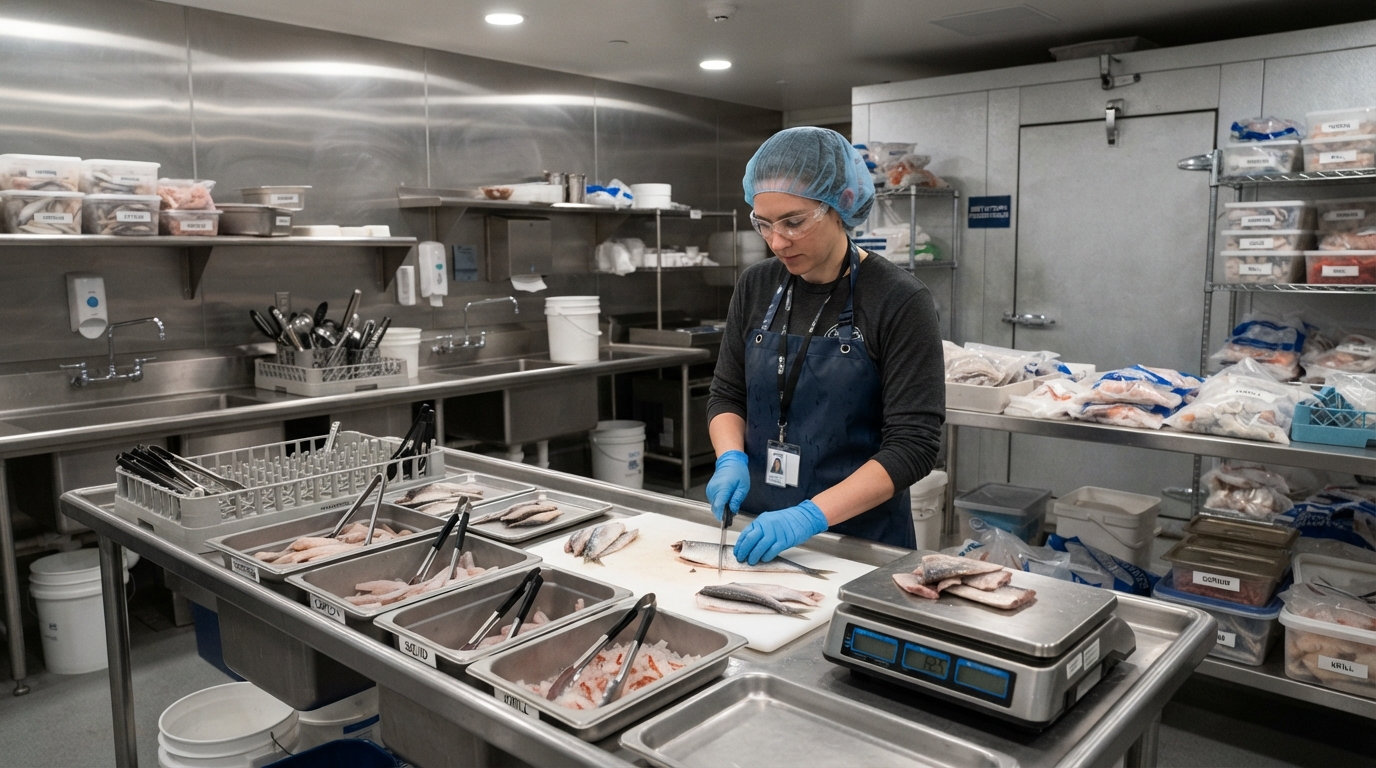
Behind every public aquarium's exhibit floor sits a room most visitors never see: the diet preparation kitchen. It functions less like a seafood market and more like a hospital pharmacy, because what leaves that room directly determines the nutritional status, disease resistance, and longevity of a taxonomically diverse collection. The science behind it spans food microbiology, vitamin chemistry, and species-specific nutrition — and getting it wrong has measurable husbandry consequences.
Why Diet Prep Is a Dedicated Operational Function
A single aquarium collection can include teleost fish, elasmobranchs, marine mammals, birds, and invertebrates, each with distinct metabolic requirements, prey preferences, and sensitivities. The Association of Zoos and Aquariums' Nutrition Advisory Group (NAG) has long emphasized that frozen/thawed fish and meat items fed to captive animals require documented receiving, storage, thawing, and quality-control procedures specifically because these items are a primary, controllable source of nutritional and microbial risk in captive diets (Crissey et al., 2001). Treating diet prep as "just feeding" ignores that prepared diets are the main lever institutions have over an animal's actual nutrient intake, since wild foraging variability is removed entirely.
Nutrition Science Behind Multi-Species Diet Formulation
Formulating diets for mixed collections requires reconciling caloric density, fatty-acid profile, and micronutrient content across very different consumers. A persistent finding in zoo and aquarium nutrition literature is that supplementation protocols vary widely between institutions, often dosed by diet volume rather than by caloric or nutrient content — a practice that produces inconsistent intake because high-fat fish species receive proportionally less supplement per calorie than lean species, even though fat-soluble vitamin needs scale differently (Mazzaro, Koutsos & Williams, 2016). The same review notes that over-supplementation of fat-soluble vitamins, particularly vitamin A, carries real toxicity risk, underscoring that diet formulation is a balancing act, not a default "add more vitamins" exercise. For piscivorous species such as penguins and pelicans, feeding multiple fish species rather than a single species is recommended specifically to avoid both nutrient gaps and the behavioral and supply risks of dependence on one prey type (Merck Veterinary Manual).
Food Safety and Cold-Chain Management
Prepared seafood-based diets carry the same bacterial risks as retail seafood, and some risks are amplified by batch handling. Early work on captive-animal diets found that meat and fish held at room temperature rapidly accumulate bacteria and spoil, while thawing under refrigeration (around 4°C) produces substantially lower microbial growth than thawing at warmer temperatures (Crissey et al., 2001). Pathogens such as Salmonella, E. coli, and Staphylococcus can survive freezing and resume growth on thawing, and Clostridium botulinum spores can germinate and produce toxin at temperatures as low as 3°C if holding times are not controlled. The U.S. FDA's hazards-and-controls guidance for fish and fishery products similarly specifies that ready-to-eat and raw fish products be held at or below 4.4°C (40°F) through receiving and storage, and sets explicit time limits for histamine-forming species and for pathogens like Vibrio and Listeria monocytogenes once product temperature rises above 10°C (FDA, 2022). In practice, this translates into refrigerated (not ambient or running-water) thawing, sanitized cutting surfaces between species and feed sessions, segregated raw-handling zones, and strict discard windows — typically within 24 hours of thaw — to prevent cross-contamination between prey batches and across the collection.
Nutrient Degradation in Frozen Fish Diets
Freezing does not stop nutrient loss. A controlled study of whole fish stored at −20°C for up to six months found significant declines in vitamins A, D3, and E over the storage period, while trace minerals such as iron, zinc, and selenium remained stable (Gimmel et al., 2022). The same study found thiamine (vitamin B1) below detectable limits in the large majority of herring and capelin samples tested — not primarily from storage time, but from endogenous thiaminase activity already present in the fish. Thawing method mattered less than storage duration for most nutrients, though vitamin A concentration varied significantly by thawing technique, reinforcing why institutions standardize refrigerated thawing rather than leaving it to individual keeper discretion.
The Thiaminase Problem and Why Supplementation Is Required
Thiaminase I is an enzyme present in a range of common forage and prey fish — including herring, smelt, alewife, and capelin — that enzymatically breaks down thiamine before it can be absorbed by a predator consuming that fish raw (Edwards et al., 2023). This is not a hypothetical concern: diet-induced thiamine deficiency has been documented in captive marine mammals fed fish-based diets, and thiamine deficiency more broadly causes reduced reproduction, neurological impairment, and population-level effects in wild fish and wildlife that rely on thiaminase-rich prey (USGS, Columbia Environmental Research Center). Because the enzyme activity — not just storage time — drives the loss, thiamine cannot be preserved by freezing or careful handling alone. Standard practice for piscivorous species is direct dietary thiamine supplementation, commonly cited in the 25–35 mg/kg fish range, alongside vitamin E supplementation since most fish are also naturally deficient in that nutrient (Merck Veterinary Manual; Mazzaro, Koutsos & Williams, 2016). Getting the dose, delivery, and species-specific fish mix wrong is a documented pathway to clinical deficiency, which is precisely why diet kitchens track fish species composition, supplement lot dosing, and feeding records as a formal husbandry control rather than an afterthought.
Diet-prep kitchens are one piece of the back-of-house infrastructure that keeps a collection healthy — see how ADEC Dubai designs integrated aquarium facilities.
Learn moreWhy can't aquariums just feed whatever fish is cheapest or most available?+
Different forage fish species vary in fat content, thiaminase activity, and fat-soluble vitamin levels, so relying on a single species risks both nutrient gaps and accumulated deficiencies such as thiamine loss (Merck Veterinary Manual; Edwards et al., 2023).
Does freezing fish destroy the nutrients before it even reaches the kitchen?+
Freezing slows but does not stop degradation of fat-soluble vitamins A, D3, and E over months of storage, and it does not inactivate thiaminase, which continues to break down vitamin B1 independent of storage time (Gimmel et al., 2022; Edwards et al., 2023).
What is the single biggest food-safety risk in a diet-prep kitchen?+
Temperature control during thawing and holding is the primary control point, since bacteria that survive freezing resume growth once fish warms above refrigeration temperature, and Clostridium botulinum can produce toxin at temperatures as low as 3°C (Crissey et al., 2001; FDA, 2022).
- Crissey, S.D., Slifka, K.A., Shumway, P., & Spencer, S.B. (2001). Handling Frozen/Thawed Meat and Prey Items Fed to Captive Exotic Animals. AZA Nutrition Advisory Group.
- Edwards, K.A., Randall, E.A., Wolfe, P.C., Angert, E.R., & Kraft, C.E. (2023). Dietary factors potentially impacting thiaminase I-mediated thiamine deficiency. Scientific Reports, 13, 7008.
- Gimmel, A., et al. (2022). Effects of Storage Time and Thawing Method on Selected Nutrients in Whole Fish for Zoo Animal Nutrition. Animals, 12(20), 2847.
- Mazzaro, L.M., Koutsos, E.A., & Williams, J.J. (2016). Current practices in aquatic animal supplementation. Journal of Zoo and Aquarium Research, 4(4), 202–208.
- U.S. Food and Drug Administration (2022). Fish and Fishery Products Hazards and Controls Guidance (4th ed.).
- U.S. Geological Survey, Columbia Environmental Research Center. Thiamine (Vitamin B1) Deficiency in Fish and Wildlife.
- Merck Veterinary Manual. Nutrition in Piscivorous (Fish-Eating) Birds.
- Lepkovsky, S. (1948). Thiaminase in Fishery Products: A Review. Commercial Fisheries Review, 10(4). NOAA Fisheries.
Written and reviewed by ADEC's in-house aquarium life support and recirculating aquaculture engineers. ADEC designs, builds and operates turnkey aquarium and RAS facilities across the GCC, and is a member of the European Union of Aquarium Curators (EUAC), EUOTA and the European Aquaculture Society (AquaEAS), with CE-certified OCEANTECH™ equipment.
Get new articles in your inbox
Occasional, science-based insights on aquarium LSS and RAS aquaculture. No spam.