Live Feed Culture Systems and Biological Load in Aquarium LSS Sizing
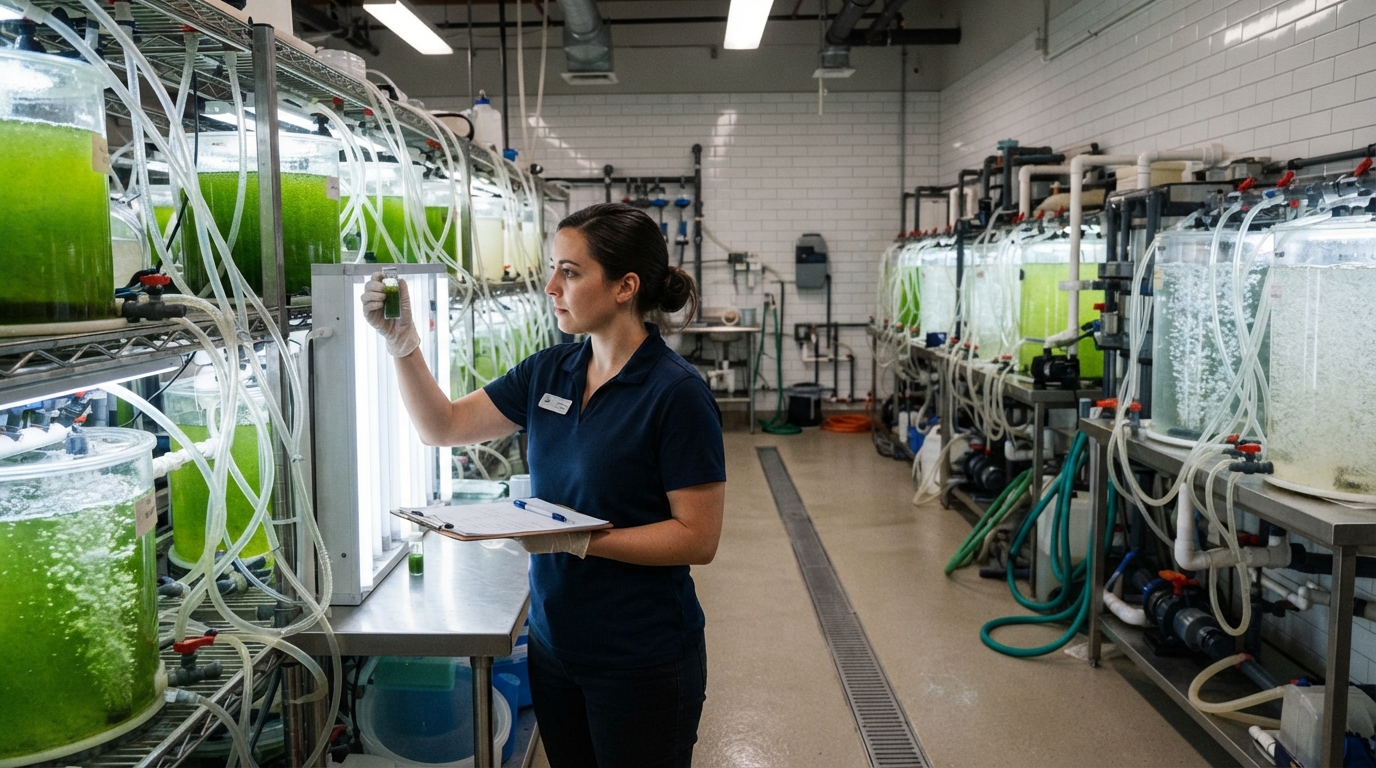
Public aquariums that rear larvae, grow out delicate juveniles, or maintain finicky planktivorous display species depend on back-of-house live-feed culture: rotifers, copepods, Artemia, and microalgae grown on site in dedicated tanks and carboys. These culture systems are biological production units in their own right, and the organic and nitrogenous waste they generate is routinely left out of life support system (LSS) biofiltration and oxygenation calculations — an omission that can leave a facility's biological load undersized.
Live Feed Culture Is a Production System, Not a Feeding Detail
Intensive rotifer culture is typically run at target densities approaching 1,000 rotifers/mL, with reported peaks near 10,000/mL, and growth rates of 20–30% per day under batch or recirculating protocols (Delbos et al., 2024a). To sustain that productivity, culturists are directed to hold total ammonia nitrogen at or below roughly 5 ppm and dissolved oxygen above 4 ppm, which in practice requires daily 20–30% water exchanges, floc traps, and — in recirculating formats — dedicated biological filters and foam fractionators running two to five tank turnovers per day (Delbos et al., 2024a). That is, by any definition, an active biofiltration system layered on top of the display LSS, not a passive feeding appliance.
Artemia culture carries a parallel requirement. Cyst hatching and biomass enrichment are stocked at 2–5 g of cysts per liter and require continuous bottom aeration to keep cysts suspended and dissolved oxygen above roughly 2.5 mg/L, since biomass production is inhibited below about 2 mg O₂/L (Delbos et al., 2024b; FAO, 1996). Brine shrimp themselves tolerate very high nitrogen concentrations, but FAO's live-food production manual notes that soluble metabolic and feed waste must still be actively removed because it drives bacterial proliferation in culture water — and describes operational tank systems that pair Artemia production with a rotating biological contactor sized at roughly 190 m² of bacterial growth surface to treat a culture volume on the order of 1,800 liters (FAO, 1996). A dedicated biofilter built specifically for a feed-culture tank is a documented commercial-hatchery practice, not a hypothetical.
Where the Nitrogen and Oxygen Demand Actually Comes From
Three waste streams compound inside a live-feed culture system: uneaten feed (algal paste, yeast, or enrichment emulsions), the metabolic excretion of the cultured organisms themselves, and the bacterial biomass that grows on both. University of Florida IFAS Extension's review of recirculating system design notes plainly that "solids resulting from fish waste and uneaten feed contribute a portion of the oxygen demand and toxic ammonia in the system," and that mineralization of accumulated organic solids adds further oxygen demand beyond the feeding event itself (McGee & Cichra, 2000). The same mechanism operates inside a rotifer or Artemia culture tank — only the organisms producing and consuming the waste are smaller.
Microalgae culture adds a different but equally real load. FAO's live-food manual identifies the culture medium, air supply, culture vessel, and starter culture as routine contamination vectors in dense algal batches, and describes standard water-treatment steps — filtration to 1 µm, chlorination, or UV — needed before culture water can be reused, specifically because of the bacterial and protozoan loads these systems accumulate (FAO, 1996). Dense algal cultures are also carbon-dioxide limited, requiring supplemental CO₂ dosing and continuous mixing for adequate gas exchange (FAO, 1996) — a reminder that an algal culture room has its own gas-balance dynamics that do not disappear when that water is discharged toward the main system.
Copepod culture research shows how quickly these loads can become biologically limiting. A controlled study of the calanoid copepod Acartia tonsa in intensive live-feed culture established un-ionized ammonia tolerance thresholds specifically because ammonia accumulation from excretion and uneaten feed is a recognized constraint on culture density and survival (Jepsen et al., 2015). Peer-reviewed work on rotifer batch culture reaches the same conclusion from the other direction: total ammonia nitrogen accumulation is cited as a principal water-quality failure mode in small-scale rotifer systems, prompting trials of chemical ammonia binders specifically to extend culture runs (Riche, 2006).
Why This Gets Underestimated in LSS Sizing
Standard LSS biofilter sizing is built around feed-to-ammonia relationships for the display collection: the widely used industry rule of thumb that roughly 2.2 lb of ammonia nitrogen is produced per 100 lb of feed fed to the main system (Masser, Rakocy & Losordo, 1999). That ratio is a reasonable starting point for exhibit fish, but it says nothing about the feed, algal paste, and enrichment oils metered into on-site rotifer, copepod, and Artemia cultures, or about the bacterial oxygen demand those cultures generate independently of exhibit feeding. When culture-tank discharge, backwash, or harvest water is returned to the main system — or shares sump, aeration, or biofilter capacity with it — that nitrogen and oxygen demand is additive, not incidental. UF/IFAS Extension's ammonia guidance underscores why the margin matters: un-ionized ammonia is roughly 100 times more toxic to fish than the ionized form, its fraction rises with pH and temperature, and a newly activated biofilter needs six to eight weeks to build sufficient nitrifying bacteria to buffer any shortfall (Francis-Floyd et al., 2023; McGee & Cichra, 2000). A biofilter and aeration system sized purely from exhibit feed rates — with live-feed culture treated as a sideline — is working with less margin than the design implies.
Sizing Recommendations
A defensible biofiltration and oxygenation design brings live-feed culture bioload into the same mass-balance calculation as the exhibit collection, rather than treating it as a rounding error. That means logging feed and enrichment inputs to each culture system, tracking ammonia and dissolved oxygen in culture tanks on the same schedule as the display, and — where culture water is returned to or shares infrastructure with the main LSS — adding its nitrogen and oxygen demand to the biofilter and aeration capacity calculations rather than assuming it is absorbed by design margin. The historical overview of aquarium LSS engineering in the Marine Technology Society Journal frames the discipline's core task as integrating biological, chemical, and mechanical treatment to match a facility's full organic load (LaBonne, 2001) — a framing that, by its own logic, has to include every tank generating that load, not only the ones on exhibit.
Bring every culture tank into your facility's biological load calculation — talk to ADEC Dubai about full-system LSS design.
Learn moreDoes live-feed culture water need to be treated before it reaches the main system?+
Any culture discharge, backwash, or harvest water that is returned to or shares infrastructure with the display LSS should be accounted for in biofilter and aeration sizing, since it carries measurable ammonia and organic loading from feed inputs and metabolic waste (McGee & Cichra, 2000; Masser, Rakocy & Losordo, 1999).
Which live-feed organism produces the most concerning nitrogen load?+
All of them can, at culture scale: rotifer protocols target total ammonia nitrogen at or below about 5 ppm (Delbos et al., 2024a), and intensive copepod culture has documented ammonia-tolerance limits that constrain achievable density (Jepsen et al., 2015), so the limiting factor is culture intensity and water exchange rate rather than species alone.
Can microalgae culture actually add bioload, or does it only help water quality?+
Microalgae used directly in larval tanks can help stabilize water quality (FAO, 1996), but the culture systems that produce that algae generate their own bacterial and contamination loads and require active water treatment before reuse, so the production side of microalgae culture is a real input to overall facility bioload (FAO, 1996).
- LaBonne, D.L. (2001). Aquarium Life Support System Design Entering the Twenty-first Century. Marine Technology Society Journal, 35(1), 69–75.
- Delbos, B., Schwarz, M.H., Ovissipour, R., & Urick, S. (2024a). Rotifer Production (as a First Feed Item) for Intensive Finfish Larviculture. Virginia Cooperative Extension Publication 600-105/CNRE-61P.
- Delbos, B., Schwarz, M., & Ovissipour, R. (2024b). Artemia Culture for Intensive Finfish and Crustacean Larviculture. Virginia Cooperative Extension Publication 600-106.
- Francis-Floyd, R., Watson, C., Petty, D., & Pouder, D.B. (2023). Ammonia in Aquatic Systems (FA031/FA16). UF/IFAS Extension.
- McGee, M., & Cichra, C. (2000). Principles of Water Recirculation and Filtration in Aquaculture (FA-12). UF/IFAS Extension.
- Masser, M.P., Rakocy, J., & Losordo, T.M. (1999). Recirculating Aquaculture Tank Production Systems. SRAC Publication No. 452.
- Riche, M. (2006). Evaluation of a Sodium Hydroxymethanesulfonate Product for Reducing Total Ammonia Nitrogen in a Small-Scale Rotifer Batch Culture System. North American Journal of Aquaculture, 68(2).
- Jepsen, P.M., Andersen, N., Holm, T., Jørgensen, A.T., Højgaard, J.K., & Hansen, B.W. (2015). Tolerance of un-ionized ammonia in live feed cultures of the calanoid copepod Acartia tonsa Dana. Aquaculture Research.
- Lavens, P., & Sorgeloos, P. (Eds.). (1996). Manual on the Production and Use of Live Food for Aquaculture. FAO Fisheries Technical Paper 361.
Written and reviewed by ADEC's in-house aquarium life support and recirculating aquaculture engineers. ADEC designs, builds and operates turnkey aquarium and RAS facilities across the GCC, and is a member of the European Union of Aquarium Curators (EUAC), EUOTA and the European Aquaculture Society (AquaEAS), with CE-certified OCEANTECH™ equipment.
Get new articles in your inbox
Occasional, science-based insights on aquarium LSS and RAS aquaculture. No spam.