Drum and Mechanical Filtration in Large Aquarium Systems
Before water reaches biological filtration or disinfection in a public aquarium LSS, it passes through mechanical filtration — the stage responsible for physically removing uneaten food, fecal waste, and other suspended solids. At exhibit scale, where flow rates can reach thousands of liters per minute, this stage relies on the same engineering science developed for commercial aquaculture solids removal.
Why Particle Size Distribution Drives Filter Selection
Suspended solids in aquarium water are not uniform in size — they span a wide distribution from large, easily captured particles down to fine colloidal material. Research analyzing micro-particles in a commercial recirculating system found that a substantial share of total particle count falls below the capture threshold of standard mechanical screens, meaning solids removal efficiency measured by weight can overstate how much of the actual particle population is being captured (ScienceDirect, "Micro-particles in recirculating aquaculture systems"). This has direct implications for exhibit water clarity, since it is often the fine, uncaptured fraction that contributes most to visible turbidity even when a drum filter is operating correctly.
How Drum Filters Are Sized
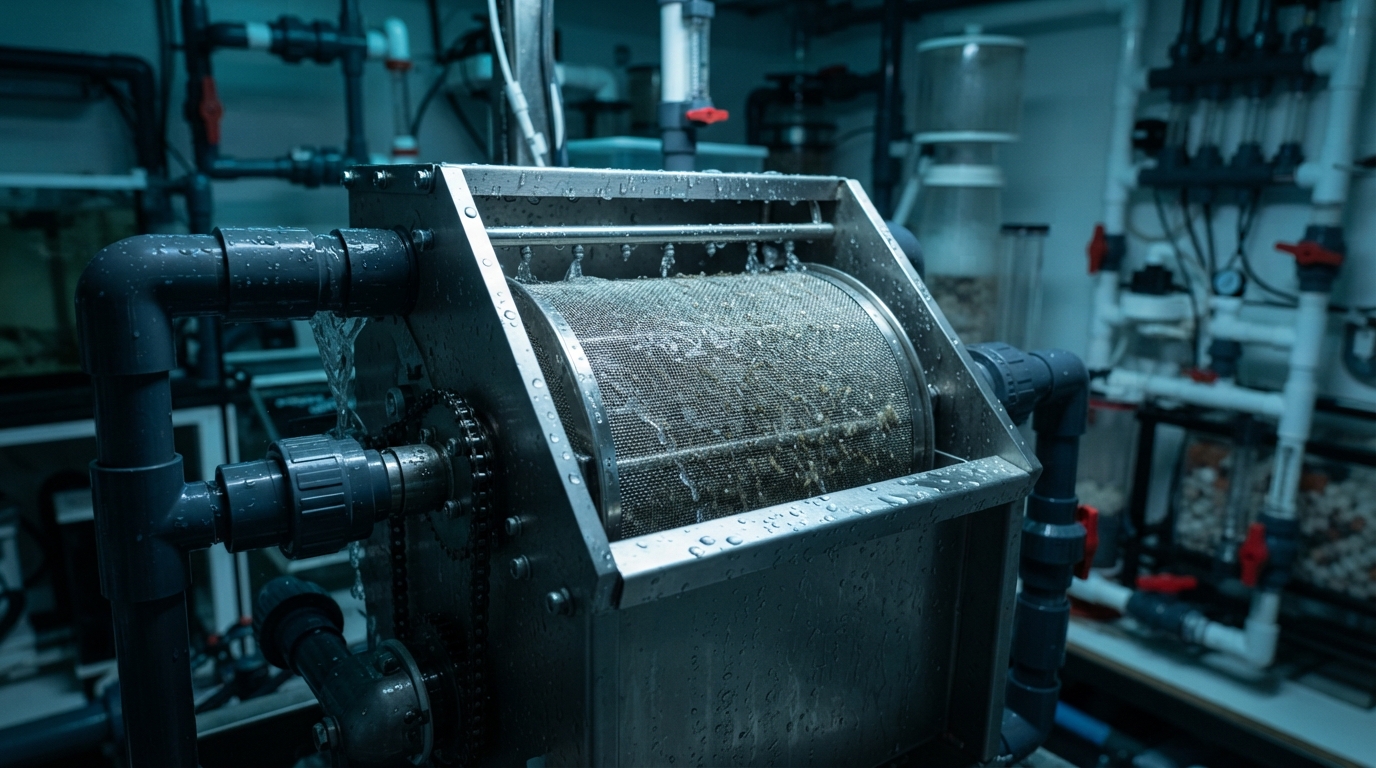
Drum filters use a rotating micro-screen cylinder, continuously backwashed, to capture solids as water flows through. Engineering research on the factors influencing optimal drum filter selection found that screen mesh size, drum surface area, and flow rate all need to be matched specifically to a system's particle load and size distribution — meaning drum filter sizing is a calculation performed for each installation, not a generic equipment choice (ScienceDirect, "Factors influencing optimal micro-screen drum filter selection for recirculating aquaculture systems"). This is reinforced by direct measurement research using particle sieve analysis to quantify the solids removal efficiency of water treatment components in an operating system, which confirmed that removal efficiency varies meaningfully depending on which particle size fraction is being measured.
Solids Load Is Not Constant Throughout the Day
Feeding events in a large aquarium exhibit create sharp, temporary spikes in solids loading rather than a constant, predictable stream. Research tracking daily micro-particle distribution in an experimental recirculating system found that particle concentration and size distribution fluctuate substantially over a 24-hour cycle, tied directly to feeding schedule (ScienceDirect, "Daily micro particle distribution of an experimental recirculating aquaculture system"). This is a key reason mechanical filtration capacity in a public aquarium LSS is sized around peak post-feeding load, not average daily solids production — undersizing for peak load is a common cause of temporary water clarity problems that appear to visitors shortly after scheduled feedings.
Mechanical Filtration Protects Everything Downstream
Solids that pass uncaptured through mechanical filtration do not simply disappear from the system — they either settle in low-flow areas, creating localized anaerobic conditions, or continue downstream where they can foul biofilter media and reduce the effective surface area available for nitrification, or interfere with UV and ozone disinfection performance by increasing water turbidity and organic load. Broader academic engineering research on solids removal reinforces that mechanical filtration performance has cascading effects on every subsequent treatment stage in the system (Benha University, "Solids Removal in a Recirculating Aquaculture System").
ADEC sizes mechanical filtration around your exhibit's real feeding-driven solids load. Explore our LSS facilities capabilities →
Learn moreWhy does exhibit water sometimes look cloudy right after feeding even with a functioning drum filter?+
Because solids loading spikes sharply during and after feeding events, temporarily exceeding average filtration capacity — this is a normal, predictable pattern rather than necessarily indicating equipment failure, though persistent cloudiness suggests a sizing or maintenance issue.
Does a finer mesh screen always improve water quality?+
Not automatically — finer screens capture more solids but require more frequent backwashing and can reduce flow rate through the filter, so mesh size is chosen as a balance between capture efficiency and hydraulic performance for the specific system.
Can mechanical filtration alone keep aquarium water clear?+
No — mechanical filtration removes captured solids, but dissolved waste and fine particles below the screen's capture threshold still require biological filtration and, in marine systems, often protein skimming to fully manage water quality.
- Micro-particles in recirculating aquaculture systems: particle size analysis of culture water from a commercial Atlantic salmon site. ScienceDirect.
- Factors influencing optimal micro-screen drum filter selection for recirculating aquaculture systems. ScienceDirect.
- Particle sieve analysis for determining solids removal efficiency of water treatment components in a recirculating aquaculture system. ScienceDirect.
- Daily micro particle distribution of an experimental recirculating aquaculture system—A case study. ScienceDirect.
- Solids Removal in a Recirculating Aquaculture System. Benha University, Faculty of Agriculture.
Written and reviewed by ADEC's in-house aquarium life support and recirculating aquaculture engineers. ADEC designs, builds and operates turnkey aquarium and RAS facilities across the GCC, and is a member of the European Union of Aquarium Curators (EUAC), EUOTA and the European Aquaculture Society (AquaEAS), with CE-certified OCEANTECH™ equipment.
Get new articles in your inbox
Occasional, science-based insights on aquarium LSS and RAS aquaculture. No spam.