Water Chemistry for Coral Reef Aquariums: The Science
A coral reef exhibit depends on a chemical process most visitors never think about: calcification, the process by which corals build their calcium carbonate skeletons. Supporting that process reliably requires understanding the underlying marine carbonate chemistry — not just dosing calcium and hoping for the best.
The Saturation State That Governs Calcification
Coral calcification rate is directly linked to the aragonite saturation state of the surrounding seawater — a measure of how favorable the water chemistry is for calcium carbonate (in its aragonite crystal form) to form and remain stable in coral skeletons. Foundational research on the effect of calcium carbonate saturation of seawater on coral calcification, published by the U.S. Geological Survey, established this relationship directly through experimental work, demonstrating that calcification rates respond measurably to changes in saturation state rather than to calcium concentration alone (USGS, "Effect of calcium carbonate saturation of seawater on coral calcification"). This finding has been extended by more recent research: a study in Science Advances examining coral calcifying fluid chemistry found a multidecadal decoupling between the chemistry inside the coral's calcifying fluid and the surrounding seawater's saturation state, indicating corals can partially regulate their internal calcification environment — but not indefinitely or without limit as external conditions shift.
Why Calcium and Alkalinity Are Managed Together
Aragonite saturation state is not governed by calcium concentration in isolation — it depends on the combined relationship between calcium ion concentration and carbonate alkalinity (the water's capacity to supply carbonate ions). This is why reef aquarium water chemistry management centers on balancing calcium and alkalinity together rather than maximizing either independently: raising calcium without maintaining adequate alkalinity, or vice versa, does not reliably improve the saturation state that actually drives calcification, and can destabilize pH in the process. This coupled relationship is the scientific basis for why reef-focused water testing protocols track calcium and alkalinity as a linked pair rather than as separate, unrelated parameters.
Magnesium's Supporting Role
Magnesium is present in natural seawater at a specific ratio relative to calcium, and that ratio has a direct chemical function: magnesium ions interfere with the precipitation of calcium carbonate into less desirable crystal forms, helping keep dosed calcium and alkalinity in a stable, usable state within the water column rather than precipitating out prematurely. Maintaining magnesium within its natural seawater range is therefore treated as a supporting requirement for calcium and alkalinity stability, rather than a parameter with direct biological importance to corals in the way calcium and carbonate chemistry are.
Why This Matters More in Aquariums Than in the Open Ocean
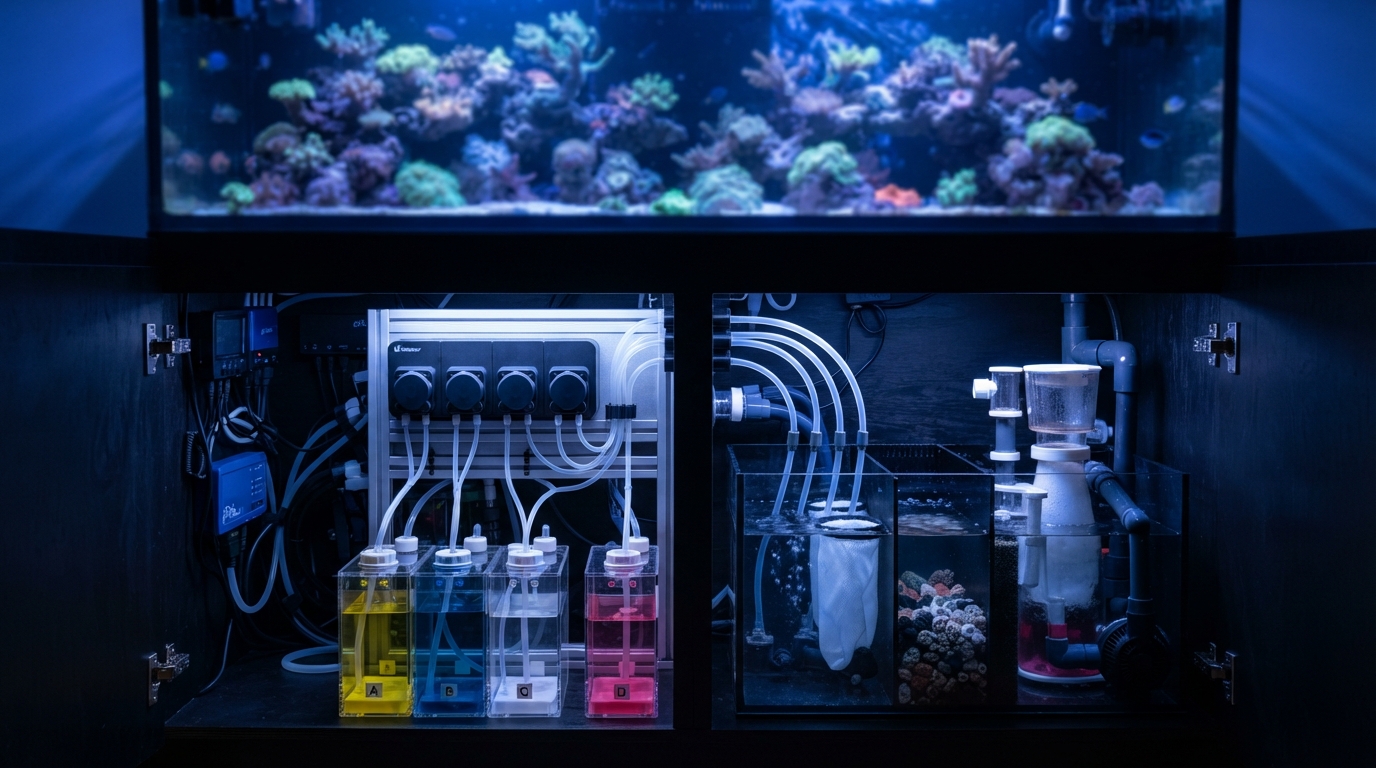
In the open ocean, calcium, alkalinity, and magnesium are effectively buffered at near-constant levels by the sheer volume of water involved. In a closed aquarium system, coral calcification continuously draws down calcium and alkalinity from a comparatively tiny water volume, meaning these parameters can shift measurably within days without active management — a dynamic that does not occur at meaningful scale on a natural reef. This is the core reason reef aquarium LSS design treats calcium and alkalinity supplementation as an ongoing, monitored process rather than a one-time water chemistry setup.
ADEC engineers dosing and monitoring systems built around real reef carbonate chemistry. Explore our LSS capabilities →
Learn moreIs calcium the single most important parameter for coral health?+
Not in isolation — research shows calcification responds to the combined saturation state produced by calcium and alkalinity together, which is why both are managed as a linked pair rather than calcium alone being optimized.
Why do reef aquariums need ongoing calcium and alkalinity dosing but natural reefs don't need supplementation?+
Because the vast water volume of the open ocean buffers these parameters near-constant, while a closed aquarium's much smaller water volume is measurably depleted by ongoing coral calcification, requiring active replenishment.
Can changes in seawater saturation state affect coral calcification on natural reefs too?+
Yes — the Science Advances research on calcifying fluid chemistry is part of a broader body of research examining how shifts in ocean carbonate chemistry affect coral calcification globally, which is directly relevant to understanding aquarium-scale chemistry management as well.
Written and reviewed by ADEC's in-house aquarium life support and recirculating aquaculture engineers. ADEC designs, builds and operates turnkey aquarium and RAS facilities across the GCC, and is a member of the European Union of Aquarium Curators (EUAC), EUOTA and the European Aquaculture Society (AquaEAS), with CE-certified OCEANTECH™ equipment.
Get new articles in your inbox
Occasional, science-based insights on aquarium LSS and RAS aquaculture. No spam.