Biological Filtration in Public Aquariums: The Science
Every stable public aquarium exhibit depends on an invisible workforce: colonies of nitrifying bacteria living on biofilter media, continuously converting the ammonia excreted by fish and invertebrates into progressively less toxic compounds. Unlike mechanical filtration, which can be inspected and cleaned on demand, biological filtration is a living system — and understanding its actual microbial behavior, not just its function, is essential to operating an aquarium LSS reliably.
The Microbial Reality Inside a Biofilter
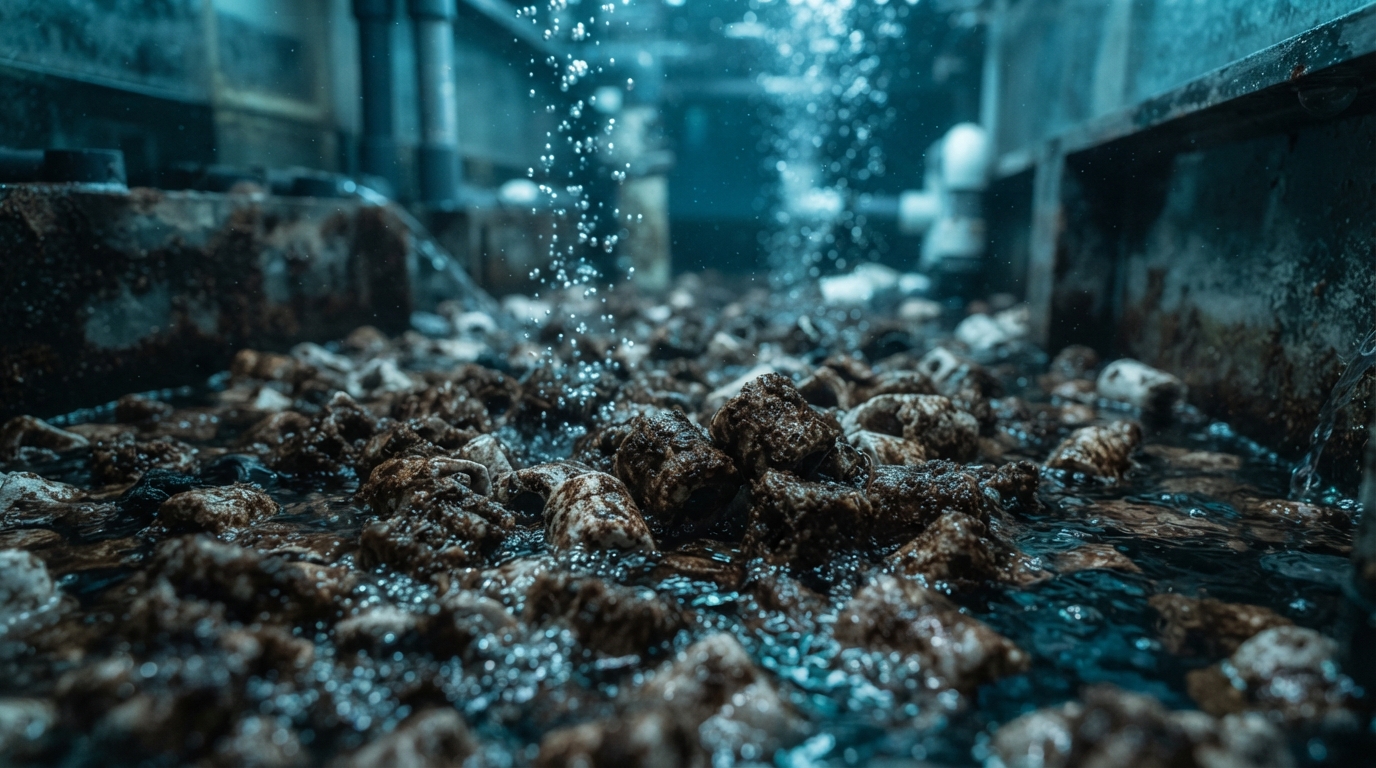
It is tempting to think of an aquarium biofilter as an unpredictable, ever-shifting black box, but peer-reviewed research actually shows the opposite: once established, its core nitrifying community tends to be notably stable. A study published in PLOS One examining ammonia-oxidizing archaea and bacteria in aquarium biofilters found that community composition remained stable over time and across different biofilter media types within the same system, with a small, consistent set of dominant organisms rather than a constantly shifting population (PLOS One, "Temporal and Spatial Stability of Ammonia-Oxidizing Archaea and Bacteria in Aquarium Biofilters"). This stability is itself operationally significant for LSS operators: it means a mature biofilter's nitrifying population is not something that needs to be continuously re-established, which is also part of why a real disruption event — rather than routine day-to-day operation — is what displaces this otherwise settled community.
The Two-Step Process: Ammonia to Nitrite to Nitrate
Regardless of which specific organisms are present, aquarium biofiltration follows the same two-step nitrification chemistry documented across the aquaculture and environmental microbiology literature: ammonia-oxidizing bacteria and archaea first convert ammonia into nitrite, and a separate group of nitrite-oxidizing bacteria then convert that nitrite into nitrate (Preena et al., 2021, Reviews in Aquaculture). Because ammonia toxicity is directly tied to pH and temperature, and because the proportion of the more dangerous unionized ammonia form rises as both increase, exhibit water chemistry directly shapes how much biofiltration capacity a given collection actually requires (University of Florida IFAS Extension, FA031: Ammonia in Aquatic Systems).
Media Surface Area and Sizing Principles
Nitrifying bacteria live as a biofilm on the surface of filter media, meaning the total available surface area — not the physical volume of media alone — governs how much nitrifying capacity a biofilter can support. Engineering research rating fixed-film nitrifying biofilters in recirculating systems found that removal performance is directly tied to surface area combined with the organic/nitrogen loading rate and water chemistry conditions such as pH, alkalinity, and dissolved oxygen — the same underlying principles that govern industrial aquaculture biofilter sizing apply directly to large-scale aquarium LSS design, since the microbiology is identical even though the application differs (ScienceDirect, "Rating fixed film nitrifying biofilters used in recirculating aquaculture systems"). This cross-disciplinary overlap is one reason LSS engineers frequently draw on aquaculture engineering literature when sizing biological filtration for exhibit volumes that can range from a few thousand liters to several million.
Why Disruption Risk Is an Operational Concern
Because nitrification depends on a living, functioning microbial community, anything that disrupts that community — a sudden drop in dissolved oxygen, a disinfectant residue reaching the biofilter, or a rapid temperature swing — can measurably reduce nitrifying capacity, sometimes for days or weeks while the community recovers. This is why aquarium LSS protocols typically treat biofilter protection as a standing operational priority rather than a one-time design consideration.
ADEC sizes and engineers biological filtration for public aquarium collections of every scale. Explore our LSS capabilities →
Learn moreHow long does it take for a new aquarium biofilter to become fully established?+
Nitrifying bacterial communities generally take several weeks to reach stable, full capacity, and research indicates that ammonia-oxidizing organisms typically establish before nitrite-oxidizing organisms — which is why new systems often show a temporary nitrite spike partway through the maturation process.
Does the type of biofilter media matter?+
Yes. Because nitrifying bacteria colonize media surfaces, media with greater surface area per unit volume can support proportionally more nitrifying capacity, which is why media selection is a specific engineering decision rather than an interchangeable commodity choice.
Can a mature biofilter lose its nitrifying capacity?+
Yes, though research shows this is the exception rather than the norm — an established biofilter's nitrifying community tends to be stable, but events like oxygen depletion, chemical exposure, or major temperature change can still meaningfully disrupt performance even in a settled system.
- Temporal and Spatial Stability of Ammonia-Oxidizing Archaea and Bacteria in Aquarium Biofilters. PLOS One.
- Preena, P.G., et al. (2021). Nitrification and denitrification in recirculating aquaculture systems: the processes and players. Reviews in Aquaculture, Wiley Online Library.
- University of Florida IFAS Extension. FA031: Ammonia in Aquatic Systems.
- Rating fixed film nitrifying biofilters used in recirculating aquaculture systems. ScienceDirect.
Written and reviewed by ADEC's in-house aquarium life support and recirculating aquaculture engineers. ADEC designs, builds and operates turnkey aquarium and RAS facilities across the GCC, and is a member of the European Union of Aquarium Curators (EUAC), EUOTA and the European Aquaculture Society (AquaEAS), with CE-certified OCEANTECH™ equipment.
Get new articles in your inbox
Occasional, science-based insights on aquarium LSS and RAS aquaculture. No spam.