Biofouling Control in Marine Life Support Systems
Visitors never see it, but inside the pipework, heat exchangers, and pump housings of a marine LSS, a biological process is quietly working against the system's engineering: biofouling. Left unmanaged, it narrows pipe diameters, fouls heat exchange surfaces, and increases pumping energy — and because seawater is a uniquely rich growth medium, biofouling in marine LSS is not an occasional maintenance issue but a continuous engineering constraint.
How Biofouling Actually Forms
Biofouling does not begin with visible growth — it begins within minutes as dissolved organic molecules adsorb onto any submerged surface, forming a conditioning film that makes the surface more attractive to bacterial colonization. Research on marine biofilms describes this as a successful and highly efficient microbial strategy: bacteria colonize the conditioning film, form a structured biofilm matrix, and that biofilm in turn recruits algal spores and invertebrate larvae, producing a successional sequence from microfouling to macrofouling rather than a single fouling event (Frontiers in Marine Science, "Marine Biofilms: A Successful Microbial Strategy With Economic Implications"). Materials science research examining biofouling and contaminant accretion on submerged marine structures confirms this is a physically and chemically complex process governed by surface energy, flow conditions, and local water chemistry — meaning fouling rate is not uniform across a system but varies by location based on these physical variables (npj Materials Degradation, "Understanding biofouling and contaminant accretion on submerged marine structures").
Why LSS Pipework and Heat Exchangers Are Especially Vulnerable
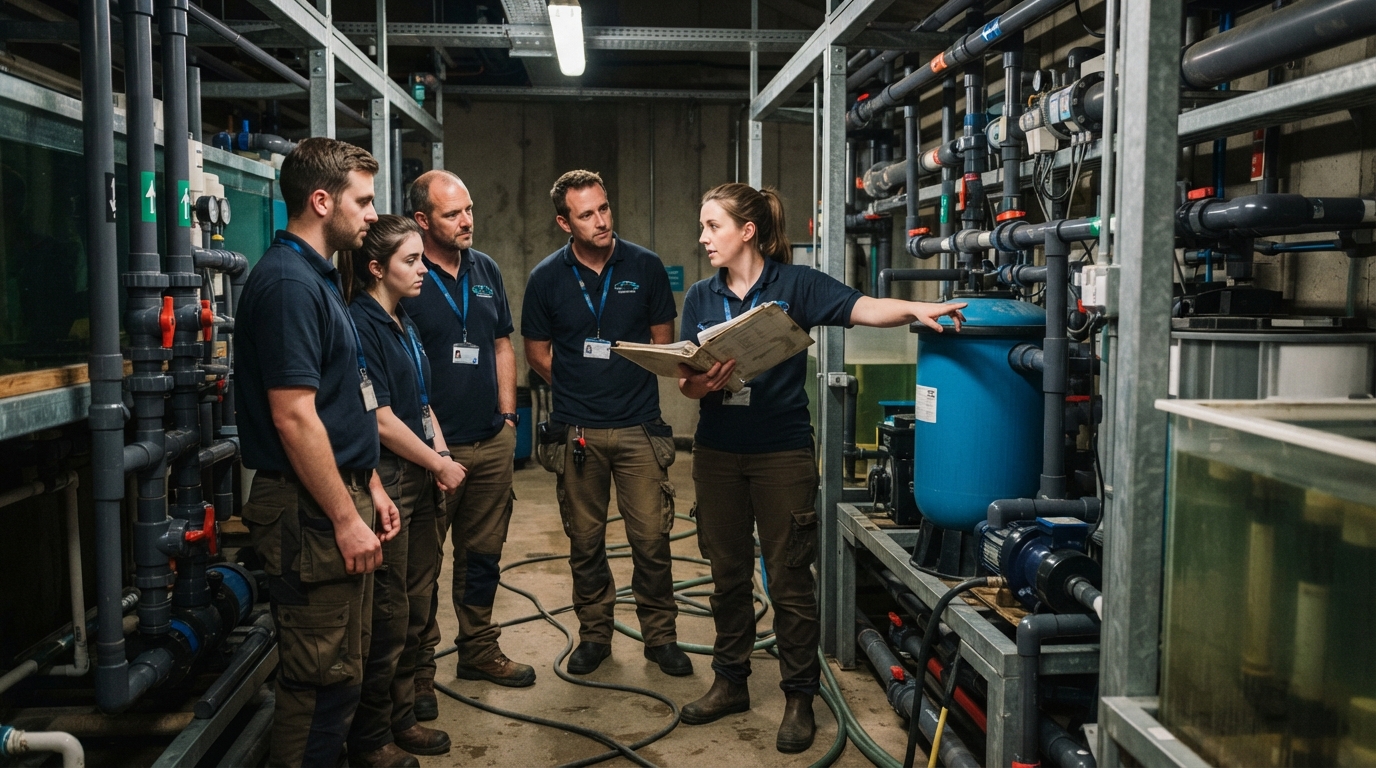
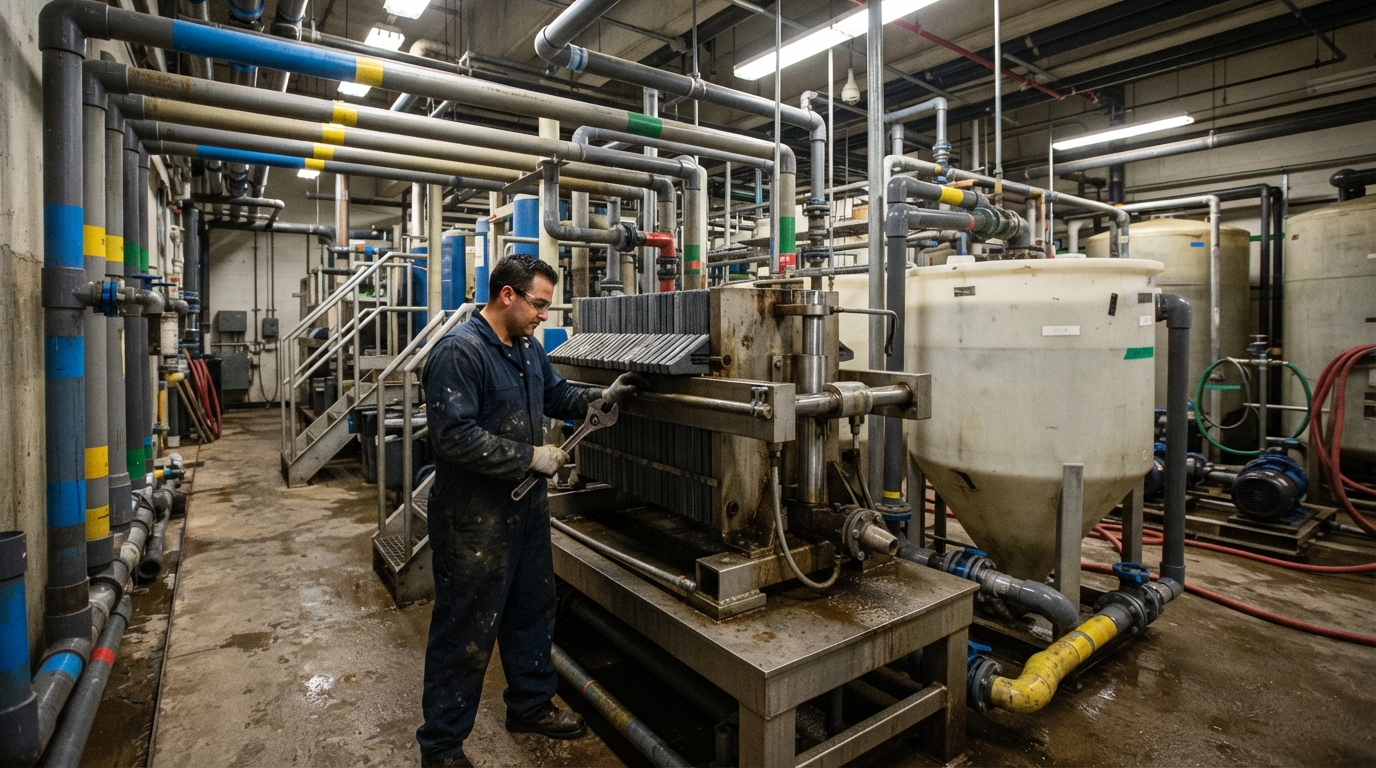
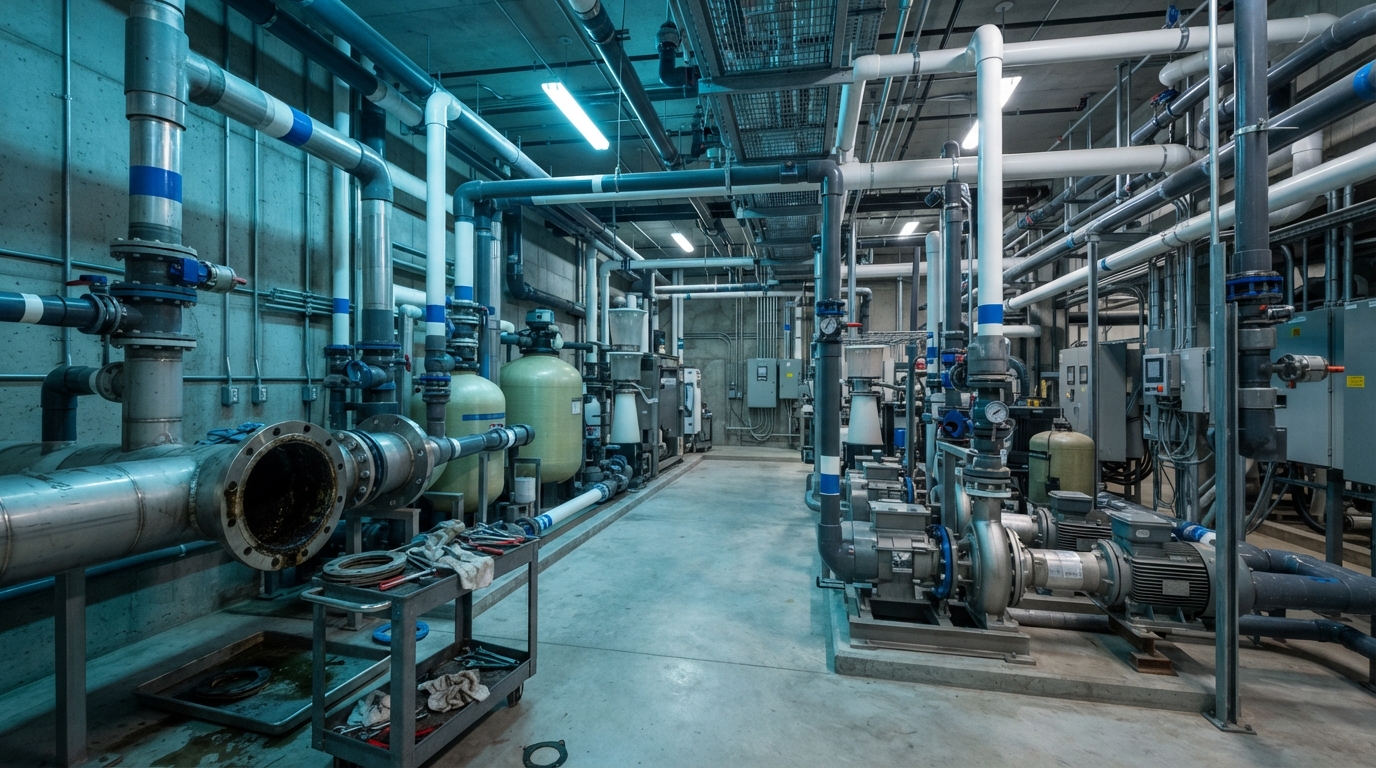
Internal seawater piping systems face a distinct fouling environment compared to external hull surfaces, since they are enclosed, often lower-flow, and can include stagnant sections. A dedicated review of biofouling in ships' internal seawater systems found that pipework, strainers, and heat exchangers are frequent fouling hotspots precisely because internal flow conditions and lower light levels favor different fouling organisms than an exposed exterior surface, and that fouling inside these systems can restrict flow and reduce heat transfer efficiency substantially before it becomes visually obvious (Frontiers in Marine Science, "A Review of Biofouling of Ships' Internal Seawater Systems"). This is directly relevant to marine LSS engineering, since exhibit systems rely on the same enclosed seawater pipe and heat exchange infrastructure, often running continuously for years without full shutdown.
Traditional Control Methods and Their Trade-Offs
Historically, biofouling control has relied heavily on biocidal approaches — chlorination, copper-based treatments, and other chemical dosing — to prevent colonization. A comprehensive review of antifouling strategies for marine applications notes that while these methods can be effective, growing environmental and regulatory concern over biocide toxicity and non-target effects has driven sustained research toward alternative, lower-toxicity approaches, particularly in systems where treated water may ultimately interact with a living collection (PMC, National Institutes of Health, "Development of Antifouling Strategies for Marine Applications"). This tension — between fouling control effectiveness and the toxicity risk biocides pose in systems supporting living animals — is a specific engineering constraint marine LSS designers face that industrial seawater cooling systems generally do not.
Emerging Non-Toxic Approaches
Because biocidal treatment carries direct risk in a system supporting a living collection, research has increasingly focused on physical and biological control strategies that do not rely on toxic chemical dosing. Materials engineering research on anti-biofouling functional surfaces for marine aquaculture has developed coating technologies designed to physically discourage biofilm attachment rather than poison the organisms that attempt to colonize a surface (ScienceDirect, "Anti-biofouling functional surfaces for marine aquaculture"). A parallel and increasingly active research direction targets the biology of biofilm formation directly: quorum sensing — the chemical signaling bacteria use to coordinate biofilm development — can be disrupted with quorum sensing inhibitors, and research functionalizing seawater treatment membranes with these inhibitors has demonstrated measurable, sustained reduction in biofouling without relying on conventional biocides (ScienceDirect / PubMed, "Functionalization of seawater reverse osmosis membrane with quorum sensing inhibitor to regulate microbial community and mitigate membrane biofouling"). Related work testing quorum-sensing-inhibitor-functionalized membranes across seasonal conditions found the approach maintained biofouling control effectiveness even as the ambient microbial community shifted throughout the year — evidence that biological disruption strategies can be robust to the real-world variability marine LSS systems experience over time (npj Clean Water, "Cracking the code of seasonal seawater biofouling: enhanced biofouling control with quorum sensing inhibitor-functionalized membranes").
Why Biofouling Control Is an Ongoing Discipline, Not a One-Time Fix
Because biofouling is a continuous biological process rather than a single event, research consistently frames control as requiring ongoing monitoring and management rather than a one-time treatment. A review of methods for managing biofouling on submerged marine structures emphasizes that effective control programs combine surface engineering, monitoring, and scheduled intervention rather than relying on any single method in isolation (Frontiers in Marine Science, "Managing Biofouling on Submerged Static Artificial Structures in the Marine Environment – Assessment of Current and Emerging Approaches"). For marine LSS specifically, this means pipe flow velocity, heat exchanger design, and inspection scheduling are treated as biofouling-control variables at the design stage, not just maintenance concerns addressed after performance has already degraded.
ADEC designs LSS pipework and heat exchange systems engineered around real biofouling science. Explore our LSS capabilities →
Learn moreDoes biofouling only affect exterior underwater surfaces like hulls, or also internal LSS pipework?+
Both — and internal systems face a distinct fouling environment. Research on internal seawater systems specifically documents pipework, strainers, and heat exchangers as fouling hotspots, since enclosed, lower-flow conditions favor different fouling organisms than exposed exterior surfaces.
Are copper-based or chlorine biocide treatments safe to use directly in exhibit-connected LSS plumbing?+
This is precisely the trade-off the antifouling research literature highlights: biocidal treatments can be effective against fouling but carry toxicity risk, which is why marine LSS design generally requires careful isolation of any biocide-treated water from exhibit-connected loops, and why non-toxic alternatives are an active research area for systems supporting living collections.
Can biofouling be eliminated permanently from a marine LSS?+
No — the research literature consistently treats biofouling as an ongoing biological process rather than a one-time problem to solve, which is why effective control combines surface engineering, monitoring, and scheduled intervention rather than a single permanent fix.
- Marine Biofilms: A Successful Microbial Strategy With Economic Implications. Frontiers in Marine Science.
- Understanding biofouling and contaminant accretion on submerged marine structures. npj Materials Degradation.
- A Review of Biofouling of Ships' Internal Seawater Systems. Frontiers in Marine Science.
- Development of Antifouling Strategies for Marine Applications. PMC, National Institutes of Health.
- Anti-biofouling functional surfaces for marine aquaculture. ScienceDirect.
- Functionalization of seawater reverse osmosis membrane with quorum sensing inhibitor to regulate microbial community and mitigate membrane biofouling. ScienceDirect / PubMed.
- Cracking the code of seasonal seawater biofouling: enhanced biofouling control with quorum sensing inhibitor-functionalized membranes. npj Clean Water.
- Managing Biofouling on Submerged Static Artificial Structures in the Marine Environment – Assessment of Current and Emerging Approaches. Frontiers in Marine Science.
Written and reviewed by ADEC's in-house aquarium life support and recirculating aquaculture engineers. ADEC designs, builds and operates turnkey aquarium and RAS facilities across the GCC, and is a member of the European Union of Aquarium Curators (EUAC), EUOTA and the European Aquaculture Society (AquaEAS), with CE-certified OCEANTECH™ equipment.
Get new articles in your inbox
Occasional, science-based insights on aquarium LSS and RAS aquaculture. No spam.