Coral Propagation and Fragmentation Labs: Back-of-House Aquaculture for Exhibits
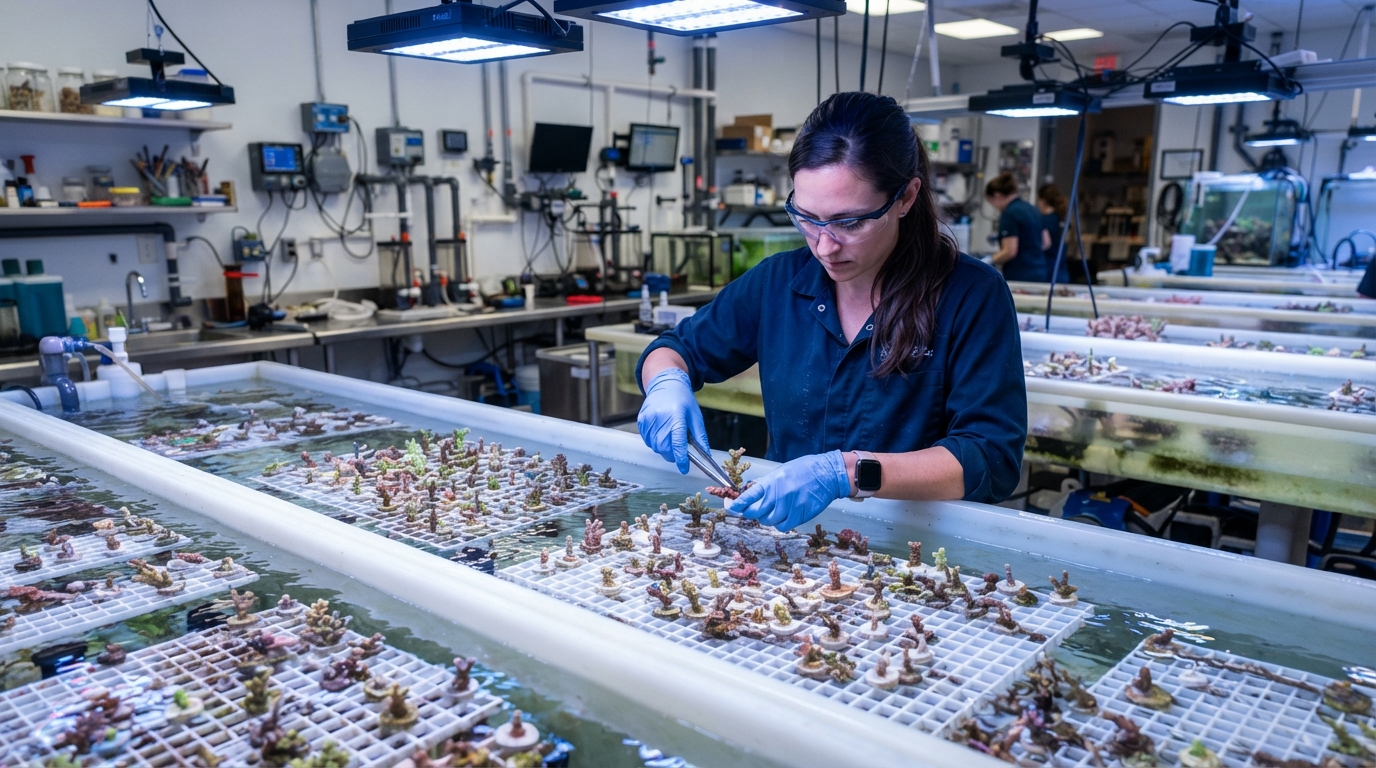
Behind most modern coral exhibits sits a quieter operation: a dedicated propagation or "frag" lab where staff cut, mount, and grow out coral fragments to supply the display floor. This back-of-house aquaculture function turns a single colony into dozens of exhibit-ready pieces, leaning on coral's capacity for asexual regeneration rather than continued removal of wild stock. This article looks at that function as a facility operation — the biology it depends on and the system requirements that make it work.
Why In-House Propagation Exists
The marine aquarium trade still draws heavily on wild-collected stock: an estimated 95% of marine fishes sold in the trade are wild-caught, and coral collection pressure has prompted growing interest in aquaculture as a lower-impact alternative, particularly at sites already under environmental stress (Dee, Horii & Thornhill, 2014; Fischer et al., 2023). A 2023 welfare and ecosystem-impact assessment of ornamental collection sites found wild-collected and aquacultured specimens showed comparable welfare outcomes in exhibit settings, but recommended aquaculture be prioritized where collection pressure on a given reef is already significant (Fischer et al., 2023). An in-house frag lab gives an institution a repeatable, traceable supply of coral biomass for exhibit maintenance and expansion without drawing further on wild colonies for every new display or replacement piece.
The Biology of the Cut: Wound Healing and Regeneration
Fragmentation works because coral tissue mounts a rapid, staged healing response to injury. Work on Acropora millepora documented four distinct regeneration stages following a cut: wound closure with exposed skeleton visible by around 6 hours, a smoothed tissue surface covering the wound by 24 hours, translucent tissue fully covering the site by 48 hours, and the first new polyp tentacles emerging within 3 to 10 days as the regenerated polyp completes development (Xu et al., 2022). At the molecular level, injury triggers rapid shifts in gene expression — early suppression of routine signal-transduction and DNA-repair activity alongside upregulation of protein-folding, cytoskeleton-reorganization, and extracellular-matrix remodeling genes, with FGF, Wnt, and JNK signaling pathways all activated during the earliest healing phase (Xu et al., 2022). The same study found this regeneration timeline held consistently across both controlled aquarium systems and natural flow-through conditions, which is part of why fragmentation is a viable production method indoors, not only on the reef.
Thermal stress interacts with this process in a way frag labs need to respect. In a controlled study across several reef-forming coral species, mortality following fragmentation reached 100% for most species after 60 days at 32°C, while regeneration rates actually increased with temperature up to a point — the coral's wound-healing response intensified under heat stress even as overall survival collapsed (Dias et al., 2018). In other words, a faster-looking healing response is not evidence of a stable system; it can mask that a fragment is running out of energetic reserve.
Attachment: How a Frag Becomes a Fixed Colony
A freshly cut fragment has to physically anchor to a plug or substrate before it can grow as a stable colony, and this happens in sequence rather than all at once. Research tracking fragment attachment in Acropora millepora described three overlapping phases: an initial 0–5 day contact-response phase involving mucus secretion and deployment of mesenterial filaments to clear and sterilize the contact surface; a 3–8 day soft-tissue anchoring phase in which proliferating tissue develops muscular contractions that mechanically grip the substrate; and a 5–12 day calcification phase in which a specialized tissue extension begins depositing skeletal material to lock the fragment in place (Humanes et al., 2022). The practical implication for a frag lab is that fragments need a stable, low-disturbance position for roughly the first one to two weeks after cutting — unnecessary handling or substrate shifts during that window can interrupt an attachment sequence that has not yet reached the calcification stage.
Fragment Size and Production Efficiency
Not all fragmentation is equal in output. Comparing traditional large fragments (16–64 cm²) against "microfragments" cut to roughly 1 cm² and grown to about 6 cm² before outplanting, a Florida Keys study on two massive coral species found microfragment arrays produced roughly ten times more total tissue than equivalently staffed larger-fragment production over a 2.5-year period, with one species showing a 262% surface-area increase for microfragment arrays versus 41% for large fragments (Page, Muller & Vaughan, 2018). At the same facility, annual output rose from about 130 large fragments to an average of 3,646 microfragments per year with no change in staffing, more than quadrupling usable tissue output (Page, Muller & Vaughan, 2018). For slow-growing massive corals in particular, this sizing decision is as much a facility-throughput question as a biological one.
Grow-Out System Requirements: Flow and Stability
Once fragments are mounted, grow-out conditions — especially water flow — measurably affect both growth and survival. A Great Barrier Reef nursery study tracking 2,536 fragments found a higher-flow site consistently outperformed a sheltered site for most species on an integrated growth-and-survival metric, and the authors noted that higher flow has been associated with increased active feeding and reduced predation (Howlett et al., 2021). A separate comparison of mid-water rope nurseries in the Maldives found fragment survival exceeded 90% in both reef and lagoon settings, but Acropora fragments grew significantly faster at the higher-flow reef site, while growth rates in both habitats fell by roughly half between 5 m and 15 m depth (Dehnert et al., 2022). For a land-based frag lab, these findings translate into a design requirement: grow-out tanks need flow regimes that are both adequately turbulent and stable over time, since both species-specific preferences and depth/flow gradients measurably change outcomes.
Planning or upgrading a coral propagation and grow-out facility? Talk to our team about dedicated frag-lab life support design.
Learn moreDoes cutting a coral fragment hurt the parent colony?+
Fragmentation creates a localized wound that the colony heals through a documented staged tissue-repair process, typically completing initial wound closure within 48 hours and new polyp formation within about 3 to 10 days under normal conditions (Xu et al., 2022).
How soon after fragging can a coral frag be moved or placed on exhibit?+
Fragment attachment to a substrate proceeds through contact, soft-tissue anchoring, and calcification phases that extend to roughly 5–12 days post-fragmentation, so minimizing handling and substrate movement during that window supports stable attachment (Humanes et al., 2022).
Why do frag grow-out systems need strong, stable water flow rather than just clean water?+
Published nursery comparisons show coral growth and survival outcomes differ measurably between higher- and lower-flow conditions, with higher flow linked to increased feeding activity and, in some studies, reduced predation and faster growth (Howlett et al., 2021; Dehnert et al., 2022).
- Xu, Y. et al. (2022). Wound healing and regeneration in the reef building coral Acropora millepora. Frontiers in Ecology and Evolution.
- Humanes, A. et al. (2022). Cellular adaptations leading to coral fragment attachment on artificial substrates in Acropora millepora (Am-CAM). Scientific Reports.
- Dias, M., Ferreira, A., Gouveia, R., Cereja, R., & Vinagre, C. (2018). Mortality, growth and regeneration following fragmentation of reef-forming corals under thermal stress. Journal of Sea Research, 141.
- Page, C. A., Muller, E. M., & Vaughan, D. E. (2018). Microfragmenting for the successful restoration of slow growing massive corals. Ecological Engineering, 123.
- Howlett, L., Camp, E. F., Edmondson, J., Henderson, N., & Suggett, D. J. (2021). Coral growth, survivorship and return-on-effort within nurseries at high-value sites on the Great Barrier Reef. PLOS ONE.
- Dehnert, I. et al. (2022). Comparing different farming habitats for mid-water rope nurseries to advance coral restoration efforts in the Maldives. PeerJ.
- Fischer, B., Pempek, J., George, K. A., Flint, J., Wittum, T., & Flint, M. (2023). Using ecosystem health and welfare assessments to determine impacts of wild collection for public aquariums. PLOS ONE.
- Dee, L. E., Horii, S. S., & Thornhill, D. J. (2014). Conservation and management of ornamental coral reef wildlife: Successes, shortcomings, and future directions. Biological Conservation, 169.
Written and reviewed by ADEC's in-house aquarium life support and recirculating aquaculture engineers. ADEC designs, builds and operates turnkey aquarium and RAS facilities across the GCC, and is a member of the European Union of Aquarium Curators (EUAC), EUOTA and the European Aquaculture Society (AquaEAS), with CE-certified OCEANTECH™ equipment.
Get new articles in your inbox
Occasional, science-based insights on aquarium LSS and RAS aquaculture. No spam.