
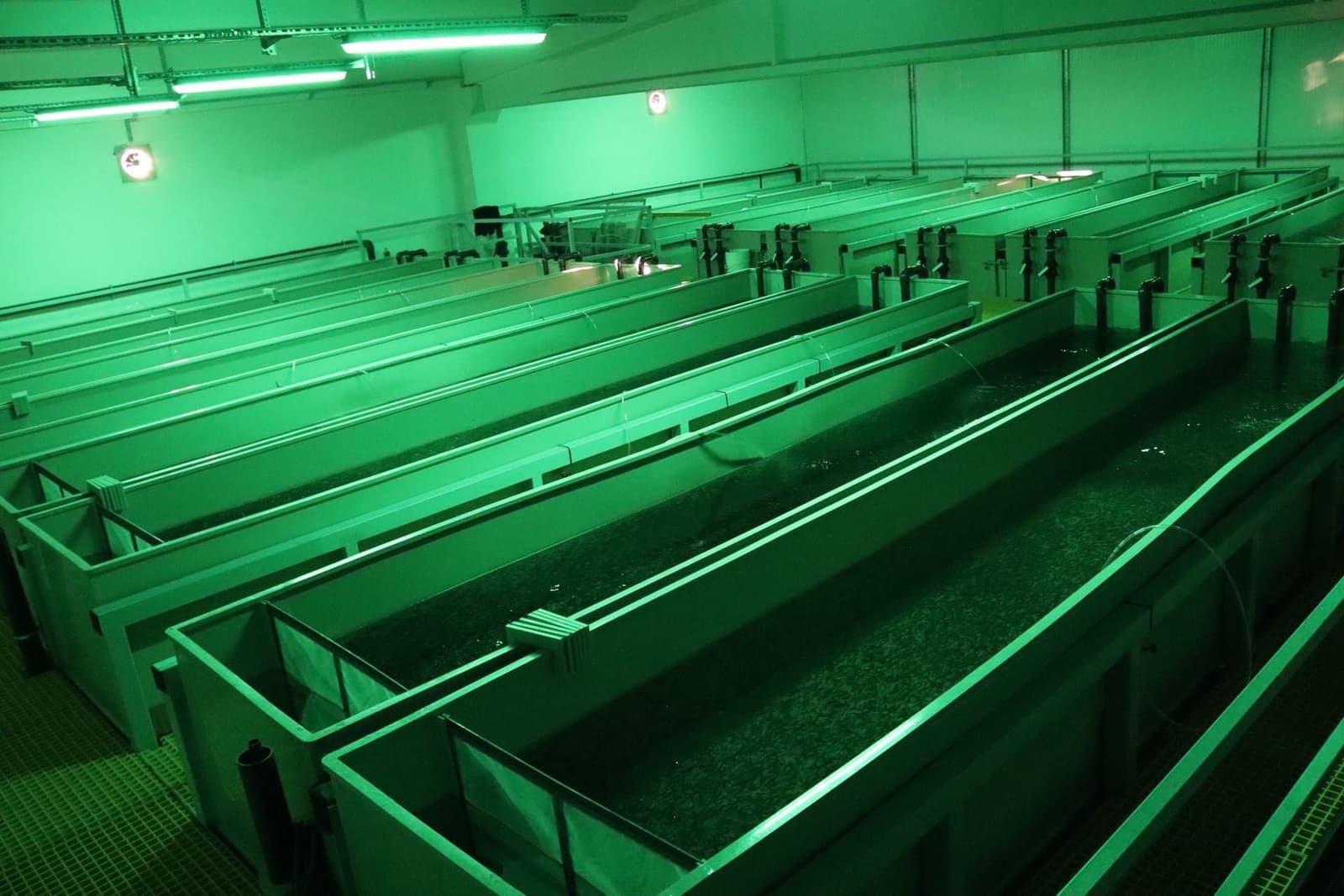
Fish farming on land, engineered like industry.
What land-based RAS fish farming is, the tank types ADEC manufactures for every production stage, and how a farm goes from drawing to first harvest — from the contractor that runs its own farm.
What is land-based fish farming?
Land-based fish farming grows fish in tanks inside a controlled indoor facility instead of in sea cages or open ponds. The enabling technology is the Recirculating Aquaculture System (RAS): instead of discharging water after a single pass, the system continuously filters, treats and reuses it — recirculating up to 99% of the water in the loop.
Each cycle takes the water from the culture tanks through mechanical filtration that removes solids, biological filtration that converts toxic ammonia into harmless compounds, degassing and oxygenation that restore the gas balance, and UV disinfection that controls pathogens — then returns it to the fish. Because the environment is engineered rather than inherited from nature, production runs year-round with high biosecurity, independent of sea temperature, weather and coastal water quality.
That combination — minimal water consumption, full climate independence and biosecure indoor production — is why land-based RAS is the fish farming model best suited to the GCC, and why ADEC builds these facilities across the region from its Dubai office. Read more on why land-based RAS or explore the OCEANTECH™ equipment behind it.
A tank for every production stage.
ADEC manufactures its culture tanks in-house from engineering thermoplastics — one of the few aquaculture contractors that builds the tanks, the filtration and the automation behind them under one roof.
Culture & grow-out tanks
Thermoplastic round and raceway culture tanks for commercial grow-out, manufactured in-house and sized around the target species, biomass and harvest plan.
Broodstock tanks
Dedicated tanks for holding and conditioning broodstock — the systems ADEC delivered for producers such as Aballıoğlu and Sürsan — engineered for stable water quality and easy handling.
Larval tanks
Larval rearing tanks paired with compact filtration skids, as supplied for shrimp and marine fish hatcheries, where the earliest life stages demand the most stable conditions.
Nursery tanks
Nursery systems that take fingerlings from the hatchery toward grow-out — the same stage ADEC runs daily at its own Milas hatchery and delivered as Nursery RAS units for Kılıç.
Raceway & adaptation tanks
Raceway tanks for flow-through style culture and adaptation — used at ADEC's Milas campus to acclimate juveniles across a 0–25 ppt salinity range before commercial production.
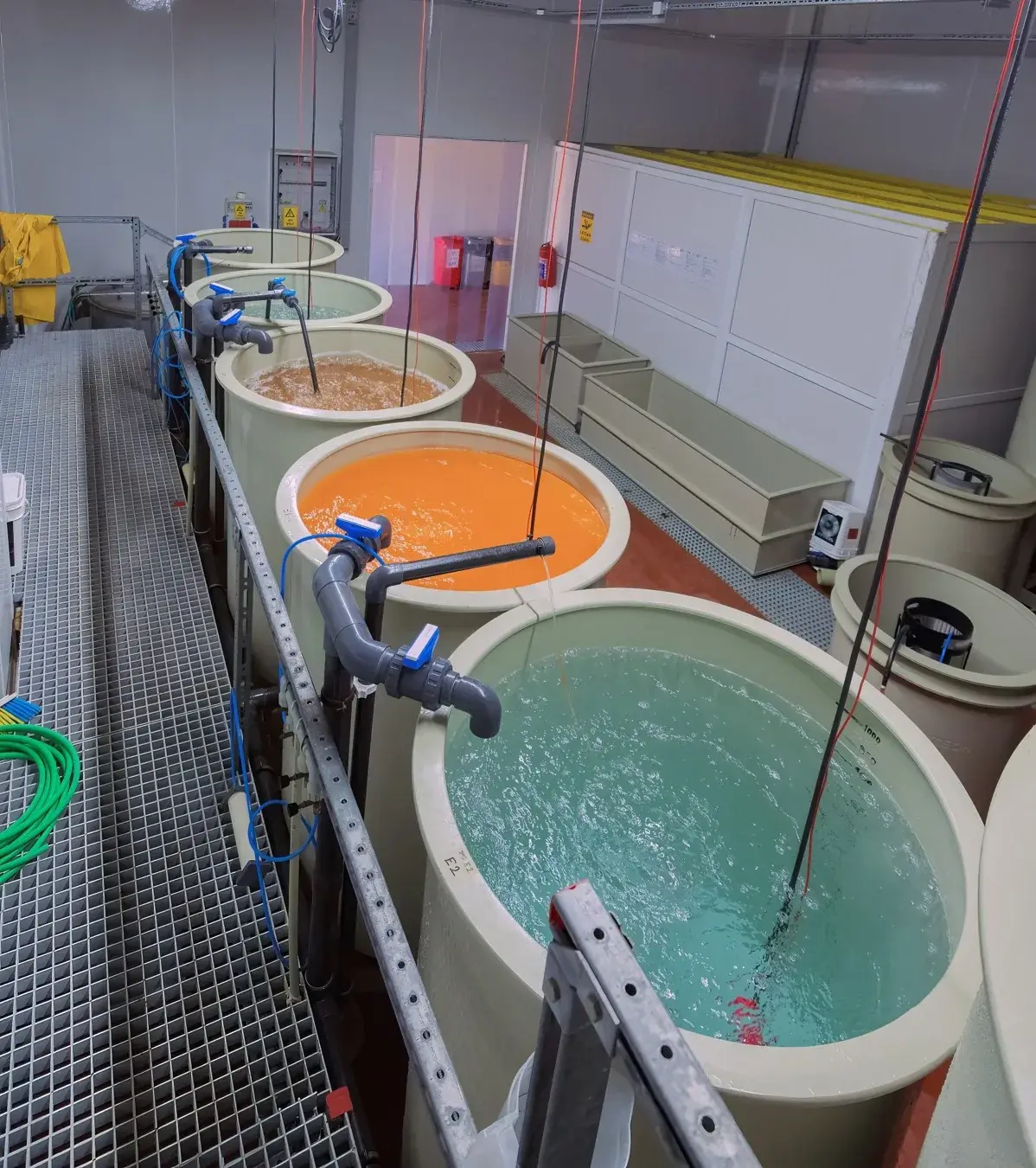
The water does the farming. Filtration keeps it honest.
Two workhorses sit at the centre of every RAS. The drum filter handles mechanical filtration — a rotating micro-screen that continuously strains uneaten feed and solid waste out of the flow before it can degrade water quality. Downstream, the biofilter does the biological work: colonies of nitrifying bacteria living on MBBR or trickling-filter media convert the ammonia excreted by the fish into far less harmful nitrate.
Around them, degassers strip carbon dioxide, oxygen cones dissolve pure oxygen into the flow, and UV systems control pathogens. ADEC manufactures all of these in-house under the OCEANTECH™ brand — see the full equipment range on the technology page.
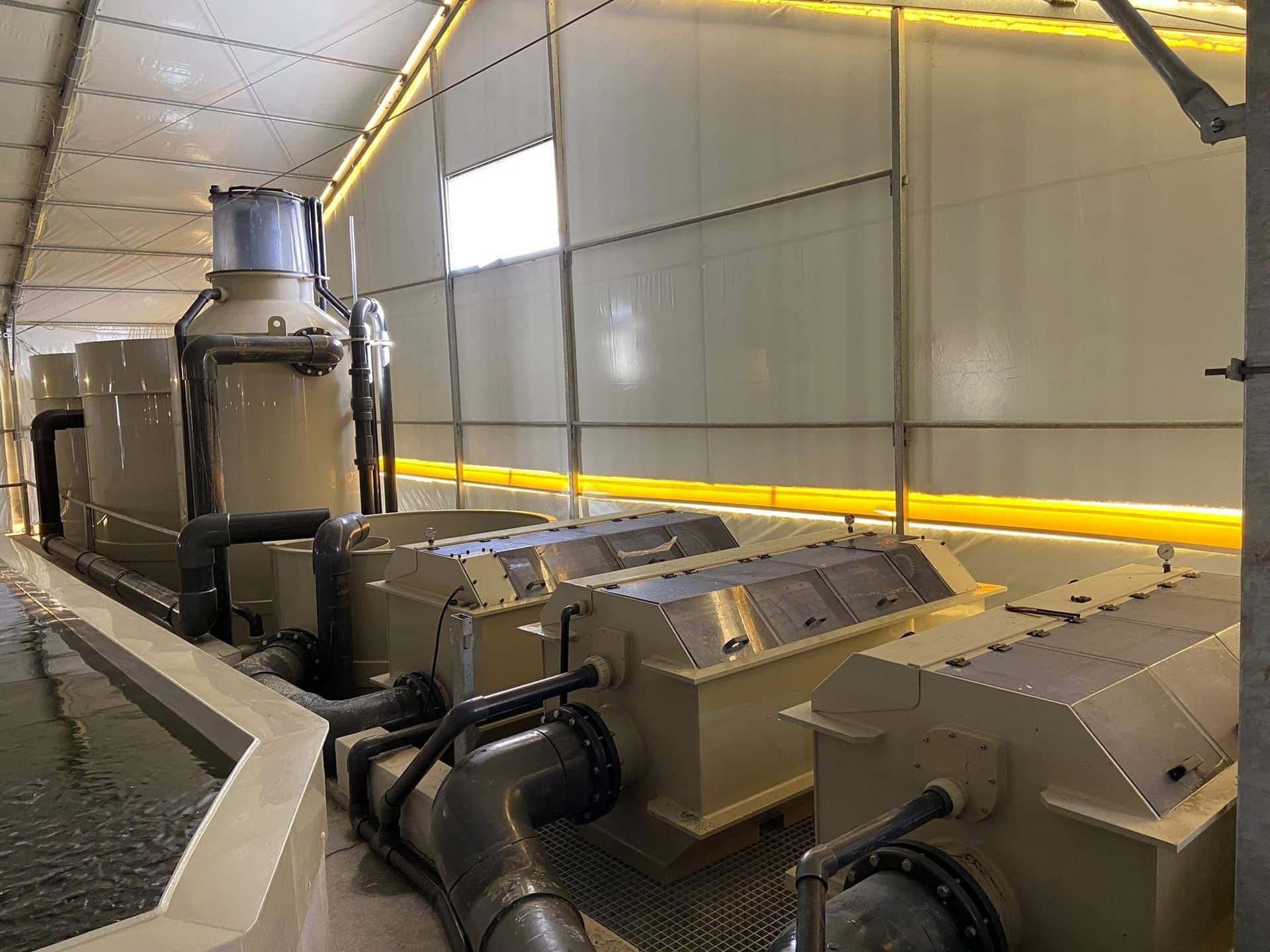
From drawing to first harvest.
Every ADEC farm follows the same five-step delivery sequence — described in full on the turnkey services page.
Design
Production planning, layout and basic design fixed around species, volume and site.
Engineering
P&ID, hydraulics, equipment sizing, electrical and automation design.
Manufacturing
OCEANTECH™ equipment built and factory-tested at ADEC's facilities.
Installation
Tanks, filtration, piping and controls installed by ADEC teams.
Commissioning
Hydraulic and biological start-up, operator training and handover.
Built, delivered and operated.
The strongest argument for ADEC's land-based engineering is the facilities already running on it.
Land-based fish farming, answered.
What is land-based RAS fish farming?+
Land-based fish farming grows fish in tanks inside a building instead of in the sea. A Recirculating Aquaculture System (RAS) filters and reuses up to 99% of the water, so the farm runs year-round with high biosecurity, independent of climate and sea conditions.
Which fish farming tank types does ADEC supply?+
ADEC manufactures thermoplastic culture and grow-out tanks, broodstock tanks, larval tanks, nursery tanks and raceway tanks in-house under the OCEANTECH™ brand, sized by its engineers around the target species and production plan.
How much water does a RAS fish farm use?+
A well-designed RAS recirculates up to 99% of its water. Only a small make-up flow is needed, which makes land-based farming practical even in water-scarce regions such as the GCC.
Can land-based fish farms operate in the GCC climate?+
Yes. RAS facilities are fully indoor and climate-independent, with temperature control engineered into the system — which is why ADEC delivers land-based projects across the UAE, Saudi Arabia, Qatar and the wider GCC.
Does ADEC operate its own fish farm?+
Yes. ADEC owns and operates the 23,335 m² Milas land-based aquaculture facility, where client teams train on live RAS equipment before their own farm starts up.
Explore more from ADEC
Why Land-Based RAS
The sustainable, biosecure case for RAS aquaculture in the Middle East.
Learn moreOCEANTECH™ RAS Equipment
Drum filters, MBBR biofilters, oxygen and UV systems for fish farms.
Learn moreMilas Operating Fish Farm
Our own 23,335 m² land-based RAS facility and client training site.
Learn more